15 octobre 2006

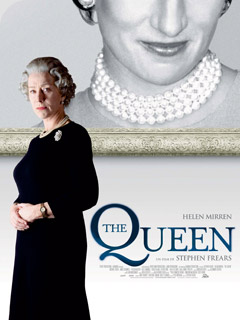
la reine et le pm


Rappelons l'anecdote. Diana Spencer se tue en voiture à Paris et ça ruine les vacances d'Elizabeth Windsor dans sa jolie résidence secondaire de Balmoral en Ecosse. Pendant ce temps à Londres, Alastair Campbell le spin doctor qui vient d'aider Tony Blair à conquérir le poste de premier ministre de Sa Majesté, invente le slogan 'Princesse du peuple' aussitôt utilisé par Tony dans son hommage télévisé à la charmante divorcée. Opération sensationnelle: Tony émeut l'Angleterre et crève le plafond de la popularité.

Mais voilà-t-il pas que la presse populaire - elle aussi -, prend à partie la reine pour son absence de réaction officielle et d'émotion publique. Chaque jour les unes des tabloids deviennent plus agressives envers la famille royale, cependant que chaque jour une foule plus nombreuse et plus grincheuse vient entasser des bouquets de fleurs devant la résidence londonienne de la reine. Tony commence à comprendre que la créature à laquelle Alastair Frankenstein et lui-même ont contribué à donner la vie, est devenue un monstre qui sera bientôt hors de tout contrôle. Là haut en Ecosse, la reine s'obstine à ignorer la populace agitée, tandis que le prince consort traque le cerf pour distraire les petits orphelins royaux au grand air. Il faut sauver la reine contre elle-même.

Finalement, Tony sincèrement inquiet pour HM et pour la monarchie, saisit une énieme fois son téléphone et dérange 'm'ame' à l'heure du thé. Cette fois, il ose hausser le ton et parvient à trouver les mots pour lui promettre du sang et des larmes si elle ne cède pas à un programme de communication de crise en quatre points, cousu main par le numéro 10 pour calmer la foule. La grande dame cède. Elle interrompt ses vacances pour revenir à Londres et se donner en spectacle comme aucun monarque britannique avant elle: message télévisé co-écrit par Alastair, funérailles nationales où elle doit coudoyer des chanteurs de variétés et des tailleurs jet-set, et mimer le chagrin comme un personnage de soap. Dans l'histoire d'Angleterre, la peuple avait déjà destitué ou décapité des rois, mais jamais on ne leur avait fait subir pareille humiliation.

The plot against Britannia

A qui profite le crime? Je vais vous le dire. Et je peux sur ce blog vous dévoiler toute la vérité sur cette affaire. L'affreuse vérité c'est que Chérie Blair (républicaine rampante) et son amant Alastair Campbell, après avoir porté au pouvoir cet imbécile de Tony, sont passé à la phase deux de leur plan en assassinant Diana à Paris. De concert avec leur complice Rupert Murdoch, ils ont alors orchestré une campagne contre la monarchie. Le complot aurait du finir en Révolution, Elizabeth abdiquant, assignée à résidence à Balmoral, tandis que Tony deviendrait Président à vie et que le couple maudit mettrait la main sur les ors de Buckingham. Le seul hic dans leur conspiration diabolique fut l'affection quasi filiale que Tony se mit à éprouver pour la vieille et qui l'amerna à sauver la couronne au dernier moment. Damned!

Now seriously...

Sérieusement je pense que la reine n'aurait jamais dû céder au diktat de la presse people et du sentimentalisme le plus écoeurant.
Que serait-il advenu? On aurait jeté des oeufs sur Buckingham et pendant quelques mois des panneaux désobligeants auraient peut-être apparus dans les foules pendant ses voyages officiels. Elle aurait peut-être été un tantinet moins aimée mais aurait conservé tout le respect du peuple. C'est tout. Au lieu de quoi, en acceptant de s'humilier à parodier des sentiments qu'elle n'éprouvait pas, et n'avait aucune raison d'éprouver, à l'égarde de son ex-bru, elle a sacrifié un morceau de sa dignité contre quoi? Une 'image' plus 'humaine'. Pouah!

Soyons clair: le destin de la monarchie anglaise et de la famille Windsor-Saxe-Cobourg m'indiffère passablement. Mais ce qui me chagrine dans cet épisode c'est que le sentimentalisme people le plus éhonté, relayé par des responsables politiques opportunistes, ait fait s'abaisser une vieille dame digne et intelligente qui pendant 70 ans avait été 'impeccable' et droite dans ses bottes de cheval.

La dernière des dames de fer

Je crois que Frears nous dit avec ce film: la seule tradition aristocratique de valeur, et typiquement anglaise, qu'Elizabeth incarnait à merveille, c'était le sang-froid, le stoïcisme, la pudeur, la 'résilience'. Les bombes allemandes n'avaient pas réussi à faire fuir George VI de Londres; les spins doctors et les tabloïds ont délogé sa fille de Balmoral en moins d'une semaine de blitzkrieg lacrymogène.

Avec ou sans ce triste épisode, le successeur de Elizabeth - que ce soit son fils ou son petit fils - aurait très certainement interrompu cette tradition stoïque pour embrasser la société du spectacle. On aurait pu au moins épargner ça à la vieille dame.

30 septembre 2006

my coming out - Atheist Pride! (ENG)

Now that I have a blog, it is time for me to make my coming out. No, not that one. My coming out as an atheist and an anti-religious guy. An atheist is not only a non-believer. It is also, to a certain extent, a citizen who is opposed to religions, superstitions and clergies, who fears and despises their influence over society and politics.

I don’t know the English equivalent of ‘anti-clérical’ but that is what I am. I am not only ‘laïc’ (non religious), I am not ‘agnostic’ and I never were. I have personally no doubt that there is no god, nor devil, nor bodhisattvas, nor Santa Claus. Fellow atheists, screw the ‘How-do-you-know?’ they give us. Can you prove that Santa Claus does not exist? Well no: if you look all around Laponia and don’t find his house, that does not mean he does not exist somewhere else; that could might mean he’s hiding very well – and that is exactly what believers believe.
We atheist don’t have to prove that there is no god. We see no god, no-one sees any god, and then we don’t see why anyone should pretend there is one, let alone impose rules based on that fiction. It is just a matter of whether or not you decide to use your brain and senses. In fact, I believe that in the modern world we almost all know that there is no god, but still too many of us don’t want to admit it, and prefer to lie to themselves, to lie to each others in a dangerous denial. For mental comfort, peer pressure, love of tradition etc.

I said ‘coming out’ because I normally don't mention my being atheist. Somehow it has become ‘ringard’ to proclaim oneself ‘atheist’ today. Many find something aggressive in the word and the idea. ‘After all, we are said by 'neutrals', why be dismissive and contemptive with those harmless, sometimes exquisite little old men that we call curés or reverends or rabbis. They are good people. Leave us alone with Saint Barthelemy, the Crusades and all the gruesome crimes of religion in the past centuries… it is not their fault’. Religion-tolerant would go on: ‘Today clergymen are sincere, they live in true poverty and they do social care’. Well NSDAP and Hamas did great welfare and social action too.

Some months ago, I had a pub conversation with a young lithuanian from office, a fervent catholic, and she was sincerely amazed and saddened to hear that I was a non-believer. Seeing her reaction, I realised how self-evident god and christian dogma was to her. But then I played the politically-correct religious-tolerant guy. I didn’t want to hurt her feelings by telling her all the things I really believe, or rather, don't believe.

I read some years ago something about scientists feeling cornered in the born-again America, who coined the term ‘bright’ to emphasize the positive aspect in being atheist. Apparently they were a bit ashamed. And indeed sometimes we atheists call ourselves ‘non-believer’, ‘non-croyant’ in an attempt to play it down. Just as ‘feminist’ has become an insult or at least an incongruity these days. Atheist, it seems, are pitiful hysterical extremists, taking religion as a scapegoat, nostalgic of the Spanish civil war or the ‘bouffeurs de curés’ in the XIXth century. I believe most conservative people think blimey it is not sport, and not fair play to shoot at poor old religion as a whole. On ne tire pas sur les ambulances. Islam may be a threat yes, but please leave harmless christians alone.

Well I think Islam is not intrinsically more dangerous than the others. Islam is just more alive and kicking than other monotheist cults today simply because it is younger and happens to be the religion of countries in social and political turmoil, struggling to embrace modernity without losing everything to Western world values.

If christianity is less dangerous than it used to be it is precisely because our atheist predecessors tamed it, and won a century-long bloody struggle that culminated in France at the end of the XIXth century, with a complete separation between State and religion. Combes, Clemenceau, Ferry are my heroes.

I think ‘non-croyant’ is as repulsive a euphemism as ‘non-voyant’. I say it: not only do I not believe in their gods, in any god, not only do I think they are lying to themselves and lying to others, but I don’t think believers and priests are some kinds of harmless poets in a materialist world. I think they are still all potentially dangerous to public good and to mankind. But I have never dared saying that in a dinner with friends. I suspect most of my friends are not believers, but some may be, I am not exactly sure, I would not want to hurt any of them, It would be rude, wouldn’t it? So I write it. That’s what blogs are for, isn’t it?

The roots of all evil


I first felt like writing my ‘atheist pride’ coming out when watching a programme by biologist Richard Dawkins on Channel Four six months ago called ‘The root of all Evil’. By the way can you imagine one second a programme attacking religion in prime time on a big French channel? Or everywhere else in the world than in the UK?

Dawkins methodologically rejects the popular wisdom that, after all, religions have done good to mankind, globally. It reminds me of Georges Marchais, a French communist leader of the 70s who, in the early 80s still dared say that Soviet Communism in Russia had been “overall positive”.

Dawkins also puts down the argument that ‘We still need to keep the fiction of god to maintain family values, and the sense of good and evil’.
After politely interviewing a close friend of that anti-abortion fanatic who killed a doctor in the US, whom he found to be a very nice person, Dawkins makes this crucial point: ‘Without religion, good people would do good things and bad people would do bad things. With religion, you can get good people to do evil things.’ Indeed there are plenty of evidence in animal societies, that family values and a sense of ‘good’ (empathy, co-operation) at the scale of a species, do not require a supernatural belief to be maintained.

Then Dawkins interviews the bishop of Oxford. The Moderate Christian man. What can be more moderate on Earth than a modern-day Anglican bishop? And indeed the man is no ignorant born-again redneck or insane ultra-orthodox rabbi or frustrated imam. He is an exquisite old man, who explains that the Bible has to be interpretated, that we can rule out literal reading of Adam and Eve, stoning adulterous women, and even maybe do without the - admittedly peculiar - virgin Birth theory, but that the belief in the resurrection of the Christ must at the core of Christian beliefs. Phew, one moment I thought he was going to tell us Christ was just an option in Christian credo. ‘Modern’ christians are really cornered. Their loss of market share to more radical, traditionalist or charismatic churches seems to show that the individuals who still want religion today, want the good old radical stupid flavour of it. They are not interested in an ‘intelligent’ form of religion.

How can we be ‘moderately’ religious? How can we cherrypick into racist, violent, supernatural codes? If you believe in virgin Birth or resurection and stuffs like that, you might as well be ready to believe anything, aren’t you? Believers are betraying rationality; moderate religious believers are betraying both religion and rationality.

Now then, maybe religion has been badly used by cynic men all along history, but the Book themselves are surely full of good, sensible things?

Few of us indeed can feel any sympathy to psychopath killers like Abraham today (a man who heard voices telling him to kill his kid: how else do you call him?). But many think monotheism is an improvement over primitive religions of barbaric times. It’s all about love isn’t it? Again, that is forgetting how cruel and primitive is the use of original sin and the sacrifice of the Son, how sadistic and masochist Christianity is. Saint Paul made sure Christianity would become this fantastic instrument of guilt. Dawkins explores the use of terror using the concept of damnation and Hell across centuries. Those who have read ‘Angela’s Ashes’ for instance, know that 50 years ago, sadistic priests were still scaring children to death with the idea of Hell and were psychologically emasculating some of them for life.

Dawkins then visits the US and meets born-again christian who are producing and touring good old spooky plays about the Devil and Hell, to scare teenagers into good.

This calm and clear, yet courageous and unimpressed, science man made me feel like standing up to my point. Since I have no balls to do it in Speakers Corner at stone throw distance from the Nation of Islam and other weirdos, I do it here.

My atheist credo

1) There are no gods or supernatural beings, unless proven otherwise. Don’t let them tell you that ‘Nobody knows’.
2) Religions have always harmed mankind and are still doing so when they get the opportunity.
3) Even in the Western world, the beast is not dead. It is still an enemy that we must keep under control. Because thank god religion is today considerably weaker in the Western world – thanks to education and great men who gave their lifes to combat religion - we must not think religion is down forever.
4) We don’t need religion to enforce a civilised society, in which people do not harm each others. We have values and we have laws.
5) There are no such things as ‘moderate’ religions. There is no cherrypicking in Holy books and letting aside their most primitive and deadly instructions. Either you believe or you don’t believe in supernatural forces and their being good guidance for us.

From that what should be the consequences in public life rules?

6) Now if, in a free society, without having been constrained in their childhood, some people still believe in gods or UFOs, this is their right and we must tolerate that (although personally the only supernatural being of whom I would tolerate the worshiping is Santa Claus, and only by under-five-year-olds). They can even speak of it publicly as long as they don’t endorse the criminal consequences of hardcore religion. I even do tolerate Tom Cruise jumping on Oprah Winfrey’s couch in a hysterical Scientologist delirium – it is quite fun actually.

7) But public authorities should not finance nor encourage organised religions or sects in any ways, as they still do today. Even in Europe we are not secular enough. I object use public money for the refurbishing of thousands of empty churches. And religious schools are no ordinary citizen associations like sport clubs or libraries, that deserve public support.

8) Going a bit further I personally think children should be protected from political or religious endoctrinement. I do not think our tolerating religion should go as far as to tolerate religious schools. Especially when science teaching is contaminated by religious thinking.

9) Finally religion should be totally ousted from the political scene. Fighting religion is not only fighting clerical states abroad. It is also stopping tolerating insidious remnants in our own societies. The beast is not dead. I am sick and tired of seeing an elected man swearing on a Bible or mentioning god in speeches, and not only in the US. it scares me to think that people who can believe in Genesis or virgin birth, who think that fanatical killers like Abraham or Moses are cool guys… are allowed to rule Government and take such important decisions like wars.
cats and dogs

I’ve asked some friends about their favourite funny English words.
And the winner is Yota, who told me ‘Not enough room to swing a cat’ What a surreal, almost sick expression to talk about a small room. I love it. It sounds Tex Averyesque to me. Surprising in a country where animal lovers get serious about pet welfare. Well it is also the country that produced 'A fish called Wanda' in which pet murder is extremely enjoyable. And I realised we say ‘Avoir d’autres chats à fouetter’, which is not very nice to cats either. Brits use another animal for this one, and say ‘To have other fish to fry.’

Another surreal saying involving cats is ‘Raining cats and dogs’. I love this one too. Less graphic, but deriving from acute animal psychology: ‘It’s like herding cats’ to mean attempting something impossible like ‘faire boire un cheval qui n’a pas soif’. Cats of course are known to be fundamentally individualist. They would never live in herds or troupeaux.

Any other surreal saying involving torturing pets?

4 septembre 2006

funny science - Pluto’s widow (ENG)

For an occasional yet loyal reader of Science & Vie like me, a big fan of 'vulgarisation', a frustrated scientist who got lost in a business school, the very fact of discovering new planets in our local solar system is emotional. It’s like finding out you have been living with someone for years in the same flat without noticing. It is emotional to have a planet disappear too. We are observing the first exo-planets some light-years away and at the same time we are still discovering small 'planets' in our solar system. Or are they really 'planets'?

Even more touching is the way the scientific community have been reacting to the discovery of the many new ‘objects’ beyond Neptune over the last three years, in what they call the Kuiper Belt. On one hand, Astronomers realised they had to define the word ‘planet’ which of course had no scientific definition so far. After Mike Brown’s team discovered the object 2003UB313 ‘Xena’ in 2003 (bigger object than Pluto), and since many other similar objects have been spotted, the astronomical community realised there are probably hundreds of icy objects about the size of Pluto in the Kuiper Belt. Scientists have to be logical and consistent; therefore either they had to call Xena and all its siblings 'planets', or they would need to downgrade Pluto to being an asteroid and no longer a ‘planet’. On the other hand, many astronomers admitted they were quite fond of Pluto and would love to find a definition that would allow to ‘keep’ Pluto in the Premiership of planethood. It is always a tragedy when your favourite team since childhood is retrograded to second division.

It has to be reminded that Pluto was hardly accepted as a planet from the beginning. Pluto was first observed by Clyde Tombaugh in 1930. It was quite a shock because since 1846 and the discovery of Neptune the 8 planets seemed to form an balanced and harmonious system – 4 telluric planets, 4 giant planets with distances from the sun growing in an elegant geometrical series. And then the former farm boy from Arkansas brought this 9th little boy, much further than the 8th planet, and much smaller – actually smaller than the moon, yes our little moon. So some at the time argued it should be called a comet or an asteroid – like the biggest objects in the asteroid belt between Mars and Jupiter.

But because Pluto was an underdog, because its discovery was a kind of Bob Beamon maverick leap in astronomy, the new kid became rapidly immensely popular. I guess for schoolboys and astronomers themselves it became the cute, late child in the family surrounded by big, big brothers and sisters. le petit dernier. So without any official decision, Pluto became de facto the ninth planet in school books and in school posters.

Retrospectively, we better realise the feat accomplished by Clyde Tombaugh in 1930. It took 76 years, tens of astronomers, digital photography and computer tracking to find more big objects beyond Neptune, only in the 90s. Back in the 20s Clyde found Pluto by looking at thousands of photographs nights after nights. It was a miracle. Again, a Bob Beamon act.

So what did astronomers decide in the end?

One month ago, at the international astronomical union (IAU) held a congress and voted a definition of ‘planet’. A planet has to: (i) circle around the sun, (ii) be round, obviously. And they added a third condition (iii) a planet must ‘dominate its own’ orbit, ie must orbit in an area it has cleared of smaller objects thanks to its own gravity/size/mass. This third condition excludes all the objects from the asteroid belt or the Kuiper from being called planets, but they can be called dwarf planets. And no-one will be forbidden to give them names, even unofficially. This will somehow alleviate the sorrow of Pluto fans. I suspect many boys will start to fancy cute dwarf planets more than big ones, just like they like hobbits, and the final impact might raise the curiosity for astronomy.

One of them had argued that the most important thing was not to disappoint children, some of whom might be disturbed to the point of giving up interest in science if deprived from their pet planet. Another one said it won’t upset current and future schoolchildren at all, but only ageing astronomers and ‘all those of us who used to be schoolchildren.’

But the most touching comment was made by the widow of Clyde Tombaugh. She is now 93 - her husband died in 97 at the age of 90 He lived long enough to start to suspect the Kuiper Belt would provide hundreds of Plutos. But he died soon enough not to see the discovery of Pluto-sized ones.

The charming old lady told the Arizona Daily Star: ‘I feel like I sort of got demoted from my job of being the wife of the discoverer of Pluto. Now I am the widow of a discoverer of a dwarf planet.’

18 août 2006

'The Sopranos'

Je découvre la Saison 1 des Sopranos avec quelques années de retard et je comprends tous les jugements dithyrambiques formulés sur la série. Je ne vais pas chercher à être original. C’est, pour moi aussi, et de loin, la meilleure fiction TV que j’aie jamais vu, et je veux bien croire les critiques qui estiment qu’il s’agit de la meilleure production TV ‘ever’.

The Sopranos est un chef d’œuvre. La série est constamment captivante sans s’appuyer uniquement ou même principalement sur l’intrigue ou le suspense. Ce sont les personnages et leur densité qui constituent le principal attrait de l’action. Comme toute grande œuvre elle offre de multiples de niveau de lecture. Hamlet et Œdipe dans le New Jersey. Sans avoir l’air d’y toucher, l’histoire va incroyablement loin sur le sujet des rapports mère fils, par exemple. Il s’agit moins d’une énième histoire de mafia que d’une chronique de la société suburbaine, de la communauté et de l’âme italo-américaine et il est tentant de voir en Tony Soprano l’archétype du male américain en crise – gangster ou pas.
Les trois personnages les plus importants des 15 dernières années – ceux qui resteront - n’ont pas inventés par le cinéma mais par les séries TV : Homer Simpson, David Brent (The Office) et Tony Soprano.

La perfection des Sopranos réside bien sur avant tout dans l’écriture, la progression maîtrisée de l’histoire et la qualité des sub-plots (je ne connais pas le terme français : sous-intrigues?): ils sont toujours pertinents, toujours en résonance subtile avec l’histoire principale, et jamais plaqués pour constituer un épisode fini – en ce sens The Sopranos est d’ailleurs plus un feuilleton qu’une série.

The Sopranos évite tous les pièges habituels des films de gangster. D’abord il arrive à concilier humour, engagement et crédibilité. C’est une comédie mais ce n’est jamais une parodie. Ensuite la violence est montrée pour ce qu’elle est, une partie du boulot, sans pudeur, fascination ou complaisance. L’interprétation évite le registre du lyrisme, de l’hystérie ou de la métaphysique, dans lesquels évoluent peut-être trop souvent les acteurs et réalisateurs italo-américains dans les films de mafia.

Enfin, d’un point de vue formel, la qualité de The Sopranos est inédite en télévision. La production, l’image et le montage sont d’une qualité hollywoodienne – dans le bon sens du terme - et sans les froufrous et effets stylistiques (caméra portée, grues, zooms, montage cut) qui peuvent agacer dans d’autres grosses productions TV comme ‘24’. L’interprétation est incroyablement solide jusque dans les rôles secondaires. Le choix des musiques jamais anodins.

La série reste totalement classique dans son style de narration et son style visuel. Confirme qu’on peut produire des chef d’œuvre sans chercher a’ innover artificiellement.

Il y a un mystère dans le sentiment de perfection qu’inspire The Sopranos. On peut être surpris quand on s’aperçoit que le créateur David Chase n’a pas lui même écrit tous les épisodes et que le que le réalisateur est différent a’ chaque épisode. Et pourtant le style narratif et visuel reste le même, aussi serré, aussi intelligent à chaque épisode. La clef du mystère bien sur réside dans le mode de fonctionement américain, la qualité des ‘bibles’, le travail des producteurs et l’instinct du commanditaire HBO.

Rappelons que Canal+ a été créé sur le modèle de HBO comme formule : sport premium en exclu, cinéma récent en exclu, et production maison haut de gamme. Mais à part dans l’humour et les talk show, et bien que non soumis à la ‘dictature de l’audience’, Canal n’a jamais réussi à produire quoi que ce soit d’important en fiction TV.

http://www.hbo.com/sopranos

6 juillet 2006

foot - 'bete noire' theory


I'd like to know the English equivalent for that French expression/concept. Serial loser? Here's the thing.
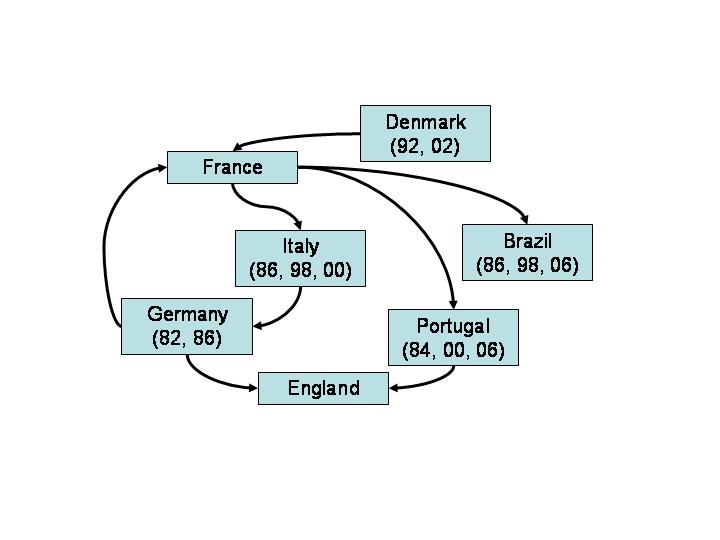
If A is the 'bete noire' of B, it means A is always beating B, even when A seems better. The 'bete noire' thing is like a curse.

The beautiful thing with 'betes noires' is that it is NOT logical or transitive.
If A BNs B and B BNs C, then A is not necessarily a BN for C. Clear huh ? The triangle FR/IT/DE is very much like that. Over the last 25 years, FR beats Italy, Italy beats DE, but DE beats FR (though we did not play since 1986).
The chart below is based on results in final tournaments - eg the 'friendly' French wins or the legendary 5-1 win of UK over DE does not count...
If the 'theory' was right, the outcome of a tournament would depend entirely upon the draw - whether or not you are to face your 'bete noire'.
So the conclusion is: thank you Italy for beating our BN Germany .....

25 juin 2006

foot - top four worst defeats ever

1. France-Germany, Seville, 1982
The perfect tragedy, like there are perfect storms. Cannot be topped, never.
You are a twelve-year-old boy, living in Gueret, not really a football fan. France is nowhere on the football map, qualified on a lucky draw, allowed to play the German ogre in semi-finals. Then the ogre is almost humiliated, led 3-1 after a fantastic goal by a Guadeloupean defender named Marius Tresor – can you believe such a name. So many things happened. Too many. 20-years-old Amoros hits the crossbar from long range; a brave Battiston – Platini’s best pal - is almost literally killed by mad goalkeeper Schumacher. Extra time. After coming back from 1-3 to 3-3, Germans win at the penalties, with a final shot by an out-of-this-world freak, the perfect Goliath, Horst Hrusbesh – can you believe such a name. You feel so sad and distressed. When the game is over and you find yourself washed out on your sofa, you love football for life and you come to realise life is unfair and France are losers. Magnificent, romantic losers. As far as I am concerned, I belong to the Sevilla generation.

2. France-Germany, Mexico, 1986
Now you are 16, living near Paris. In quarter finals, two days before, your team played the best football match ever against the great Brazil. The Platini generation is the top of its game. It could have been 5-5. But now under the overwhelming heat, the French are tired; they had two days less to rest after quarter-finals. Joel Bats makes a horrible mistake on Brehme’s free-kick. You would have tolerated losing to that magnificent Brazil – it was a close, fair, beautiful game – but losing again against Germany…. Contrary to the game four years before, this is not a dramatic tragedy but a dull, exasperating non-game, between two uninspired sides. You lose again. I still can see a disgusted, frustrated Platini sarcastically faking a shot into the ball which is in goalkeepers’ hands, in injury time. You are left empty, sad, cursed. Of course France had won the European Cup in Paris two years ago, so we are not losers after all, but that was the opportunity to heal the Sevilla wound. So the Sevilla wound would never go away. Even the 1998-2000 triumph did not erase the 1982 scar for the Sevilla generation.

3. Arsenal-Barcelona, Paris, 2006

Now you are 36. Arsenal FC is playing mighty Barca in the final of the Champion’s League in Paris. But now you live in Islington, North London, home of the Gunners. You are watching the game at home with some friends and the Arsenal shirt. After the dismissal of Jens Lehman, Sol Campbell scores a superb header. At 10 against 11, Arsenal leads 1-0 up to the 78th minute. Defence is heroic. Barca is scarcely dangerous. Then Almunia screws up twice and we lose 2-1. You are left crushed, gutted.

4. France-Bulgaria, Paris 1993

You are 23; you live in Guadeloupe. Your boss told everyone to take the afternoon off because the big game is showed at 15.00 there, of course. Perfect nightmare scenario. France had to secure one draw in its two last games at home, against Israel and Bulgaria, to qualify for the world cup 1994 in the USA. Remember we had not qualified for the 1990 world cup in Italy. But this time we did well in qualifications – we just need one point in two games. First we blew it against Israel. Defeat in Paris against Israel. Then against Bulgaria we are one up. Then the Bulgarian score an equalizer. At 1-1, we are still qualified. Then comes the 92nd minute, twenty seconds to go and we are qualified. Then the impossible happens. We lose possession stupidly, fast Bulgarian attack and they score casually, and the referee whistle the end of the world. Roland and Larqué cannot find their words. It just cannot have happened.

Among the most painful defeats, I would add Marseille-Belgrade 1991. Nobody knew at the time that Tapie’s OM was a bunch of cheaters. OM controlled the game, with lots of chances, but it ends at 0-0 and Marseille loses at the penalties. France-Denmark 1992 in the European Championship was pretty bad too, because coach Platini side had done splendidly in the qualification.
On the other hand, France-Denmark 2002, and France-Greece 2004 came as reliefs. We were so bad during those competitions that it had to stop – someone had to finish us off.

16 juin 2006

'A short story of tractors in the Ukrainian'

En France les romans sont d’abord publiés dans des gros volumes très chers avec des couvertures ‘sobres’ et une jaquette prétentieuse, puis quelques mois plus tard dans des collections de poche, beaucoup moins chères. Ici les bouquins paraissent dans un format intermédiaire, et les couvertures sont toujours illustrées. En France on aime bien se moquer des couvertures brillantes, roses, en relief, des romans d’amour d’américains ; encore une preuve de la vulgarité des anglosaxons. C'est vrai que presque tous les livres anglosaxons ont droit à une couverture illustrée, avec, des la deuxieme édition, les éloges des critiques écrit dessus. Cela n’est pas déshonorant, ni pour l’auteur, ni pour l’éditeur de placer un dessin divertissant et coloré en couverture d’une histoire divertissante et colorée. En France on pense qu’un bon livre ou un bon vin n'ont pas besoin d'un emballage attrayant. Chiant est synonyme de bon goût et de qualité.

Tout cela pour dire que c’est la couverture de ce livre qui a attiré mon attention, puis la quatrième de couverture.
Dans ma série ‘petits livres drôles, touchants, courts et faciles à lire en anglais’, après Paasilinna et Mark Haddon (janvier), voici Marina Lewycka.

‘A short history of tractors in the Ukrainian’ ah oui c’est le titre aussi qui m’a plu tout de suite, ça pourrait le titre d’un film de Kaurismaki.

Alors citons-la, la quatrieme de couverture: ‘Sisters Nadezhda and Vera must put aside a lifetime of feuding to save their émigré eighty-four-year-old engineer father from voluptuous gold-digger Valentina. With her proclivity for green satin underwear and boil-in-the-bag cuisine, she stops at nothing in her pursuit of Western wealth, and a British passport. She explodes in their lives like a pink fluffy grenade, churning up the murky water, giving the family ghosts a kick up of the backside’.

Il parait que ça a déjà été traduit dans 27 langues, donc je suppose en français mais croyez c’est super facile et sympa en anglais.

31 mai 2006

Taffies and Jocks

I am still learning new interesting words every day.
I knew that the English were called Tommies and that they call the Irish Paddies (because of so many Patricks – Padraig among them). And I have just learnt that Wales is called ‘Taff’ and the Welsh are called Taffies and the Scots are called Jocks (because of many Jacks).
So I asked my Scot colleague David MacQueen the secret Scottish word for the English. The answer is : ‘Sassenachs’, a Doric (Scottish dialect) word which originally means "lowlander". And I am told another popular nickname for the English in Scotland and Wales is ‘bastards’.

30 mai 2006

foot - England warm up for World Cup

L’Angleterre se prépare pour la Coupe du monde de foot. Les drapeaux commencent à apparaître aux fenetres et à sortir des voitures. Les journaux consacrent une page entière chaque jour à l'état du pied de Wayne Rooney.

Je dis bien : ‘L’Angleterre’ et pas le Royaume Uni. Rappelons pour les non-footeux et non-footeuses (ce blog est non-footeux-friendly) que pour des raisons historiques, parce ce sport a été inventé dans ce pays, l’Angleterre, l’Ecosse, le Pays de Galles et l’Irlande du Nord ont eu les premiers - et ont toujours conservé - des sélections nationales distinctes. Mon collègue David MacQueen, écossais comme le nom l’indique, va rejoindre les cohortes des supporters de Trinidad et Tobago, cette petite île des Caraïbes qui affronte l’Angleterre au premier tour.

Je ne sais pas en France mais ici la télé anglaise nous abreuve tous les soirs de documentaires sur la mythique Victoire de 1966, quand l’Angleterre battit l’Allemagne en finale à Londres. Et j’ai remarqué un truc intéressant : à l’époque, les maillots étaient oranges et les supporters brandissaient l’Union jack, le drapeau britannique. Aujourd’hui en 2006 les maillots sont blancs et on ne voit dans Londres que le drapeau blanc avec la croix de Saint George, le drapeau ‘Anglais’. Face au nationalisme écossais en particulier, face à la perte de l’Empire et à l’européanisation rapide de Londres, la nationalisme anglais connaît en effet un impressionnante recrudescence.

Ce sera ma première grande compétition ici et mes amis m’ont prévenu que c’était un peu dur à vivre pour un non-anglais. Je commence à comprendre ce qu’ils veulent dire. Mais contrairement à ce qu’on pourrait craindre lorsqu’on connaît la tradition de French bashing dans la presse populaire anglaise, la France n’est pas l’ennemi numéro un en football. L’ennemi numéro un, et de très loin, c’est l’Allemagne.

Parmi les documentaires TV déjà cités, un bon nombre se focalisent uniquement sur la rivalité Anglo-allemande. Gary Lineker a un jour déclaré ‘Le foot est un jeu qui se joue a onze contre onze et à la fin c’est l’Allemagne qui gagne’. C’est vrai que depuis 1966 l’Allemagne a toujours battu l’Angleterre dans les phases finales des grandes compétitions, mais l’Angleterre aime a rappeler qu’elle a gagné les plus grandes batailles : 1918, 1940, 1966.

Je vous entends dire oui c’est pareil qu’en France, personne aime les allemands. C’est vrai et faux. Certes l’Allemagne depuis Séville 1982 est notre hantise et c’est l’équipe qu’on adore voir perdre. Mais ce n’est RIEN par rapport à la haine hystérique des anglais contre les allemands. Dans la France ‘réconciliée’ avec l’Allemagne un programme spécifiquement consacré à cette rivalité ne serait pas politiquement correct. Ici cette rivalité on l'entretient quasi-officiellement, on a aucune difficulté à l'admettre.

Depuis que j’ai compris ça je suis vachement soulagé. Nous avons un allemand ici au boulot, et j’ai bon espoir d’être épargné par les sarcasmes de la majorité anglaise, qui devraient normalement converger irrésistiblement sur sa pauvre personne, comme jadis les bombardiers de sa Majesté sur Dresde. Daniel Schmidt est un gars sympa mais je n’irai pas jusqu'à lui proposer un front commun franco-allemand anti-anglais – je me fais discret et chacun sa merde.

Pour illustrer, au delà du foot, l’obsession anti-allemande des anglais, j’aimerais vous raconter un épisode de Fawlty Towers, la série comique de John ‘Monty Python’ Cleese dans les années 70. Mr Fawlty (Cleese), directeur d’hôtel, reçoit des clients allemands (tout ce qu’il y a de décents) et donne la consigne à tout le personnel : ‘Don’t hurt them ; don’t mention the war’. Mais c’est évidemment lui-même, dans une scène hystérique et surréaliste, qui multiplie les lapsus sur la guerre et les stéréotypes anti-allemands.
Un client allemand : Please stop mentioning the war !
Fawlty : I don’t, you did, you started it !
Client: No we didn’t!
Fawlty: Yes you did! You invaded Poland!

19 mai 2006

foot - heartbreaking week for Arsenal (ENG)

Weird week really.
Wednesday night saw a Greek tragedy at the Stade de France
All the young lads - and less young ones like a fantastic Ljungberg - showed great determination and courage at 10 against 11. I cannot but think that on both goals Almunia is to blame and that Jens would have caught at least one of them (but then he is number two for some reason, Jens should have managed to stay on the pitch). I was devastated.
The statements from the referee in the press only added bitterness: he recognises that maybe he should have let the goal in and then only booked Lehmann.

A Captain is born
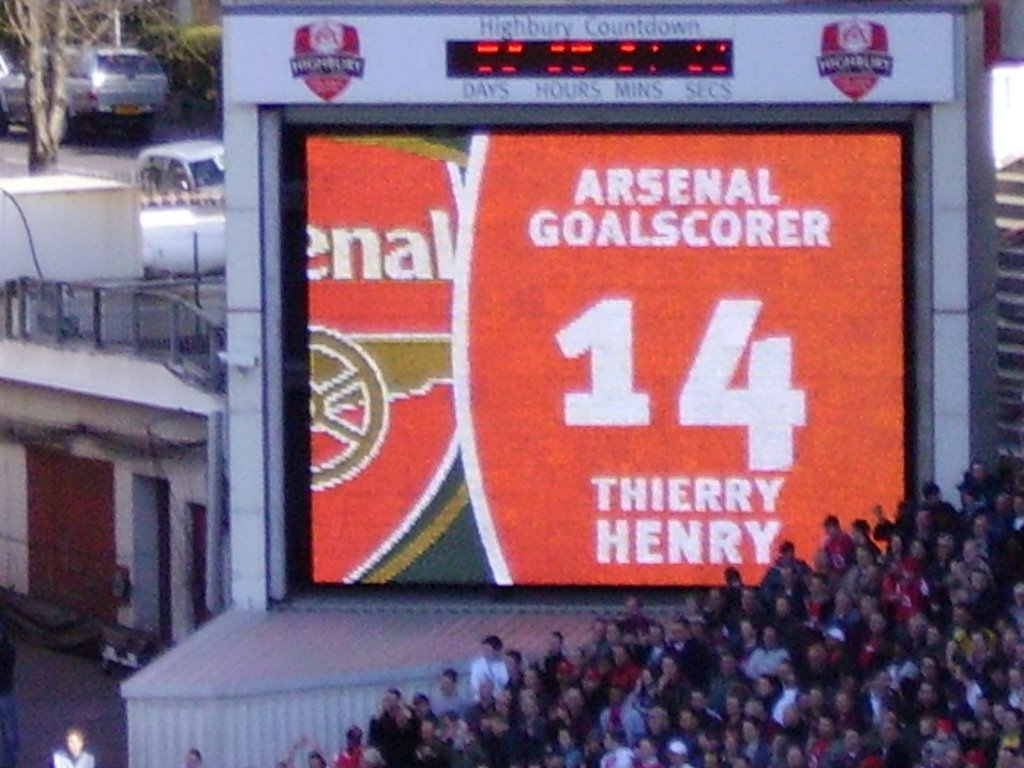
And then this morning the wonderful news: Henry is staying. A complete disastrous week it would have been otherwise...I am very happy to know that one day I'll see him at Ashburton Grove.
Although I must say i find him a bit less of a nice guy lately.
Whether or not his hesitations were sincere about leaving, he acted a bit like a Diva over the last months... Besides, honestly, I did not like very much his attitude at the end of the Final. I have seen much worse refereeing than that. But at least he is honest, he admits in interviews being a bad loser, even today when he plays against his brother and dad on a beach - and also now he is the captain, so he feels a responsibility to protect the teams' best interests at any costs. His bad temper can be read as a sign he is now fully involved in this team as a deputy coach, with a responsibility towards the young guns.

By the way funny column in the Guardian today about 'bad losers' quoting two American sayings:
'Good losers get used to lose'
'We did not lose, we just ran out of time'

Now let's see the bright side of things: had we won Wednesday maybe Henri would have left. Nobody will ever know how decisive the Wed game was in his decision, but at the last game in Highbury, his body language looked very much like he was about to go. Well we lost the trophy but we may have won four more years of Thierry magic and a still-young Captain to head the new generations of gunners.

16 mai 2006

animation - Pixar 20 years of animation (ENG)

You have some more time to go and see this exhibition at the London Science Museum (ends June 10).
It is not so much for kids but for adult fans - serious, expensive (£10), few dramatic exhibits. This is basically an educational exhibition that makes a simple point, for those who would still need to grasp it: Pixar is not about computers. Hundreds of exploratory sketches, sculptures, storyboards of characters, artworks are there to show that this is animation and storytelling. Pixar is creating stories first, then characters. Then virtual 3D puppets are created for each character and animators spend months manipulating each of them with computer programmes that play the exact same role as strings for physical puppets.
The term CGI (Computer Generated Imaging) led to misunderstandings for long. The computer is NOT generating the images of course. It must be seen as the equivalent to puppet strings or, with regard to the traditional 2D, animation computer software are only replacing the labour-intensive animation phase (shooting celluloid artwork) and gives the animators fantastic new options.

One great funny thing though: for this exhibition, Pixar have re-created a modern-day version of the XIXth century zoetrope or 'Magic Lantern' based on retinal persistence. This is beautiful and funny and epitomizes their vision: technology comes second, entertainment first.

animation - about the Pixar/Disney merger (ENG)

Managerial ‘Chinese Wall’ and multi-brand strategy are needed for the merger to be a win-win move.

1. Disney has ceased to be a creative company, and cannot become one again. Yet it needs to secure provision of high profile content for its distribution and marketing core activities.
2. This is why the Pixar-Disney distribution deal was originally a good one for both.
3. Today Disney needs Pixar's content much more than Pixar needs Disney’s marketing skills and networks.
4. The merger can yet be successful, if a ‘Chinese Wall’ ensures Disney’s marketing does not interfere with Pixar creativity, and if brands are intelligently managed.

Disney has ceased to be a creative company. Over the last 40 years it has been milking its classic film library and brand asset. Instead, Disney has become a fantastic marketing/merchandising company. The Disney brand is synonym with family entertainment. Disney is today the number seven global brand in the Interbrand ranking, right between Nokia and McDonald's. Disney finally acknowledges it simply cannot become a creative company again. Maybe one cannot successfully retain a top creative and a top marketing culture within the same film company and it takes good management to understand it and draw consequences (after all, all other majors have understood that for decades). The somehow cynic marketing approach, and the pre-eminence of marketing on creation kept the best creators away from Disney. Many great artists and producers once worked for Disney, but young Burton as well as senior Katzenberg left Disney to become immensely successful outside the empire.

Disney could accept to have no more in-house creation but it needs to secure provision of high profile content for its distribution and marketing activities. This is why the Pixar-Disney distribution deal was a good for both ; it also accelerated the global advent of Pixar.

Today Disney needs Pixar content much more than Pixar needs Disney’s marketing skills. The failure of the re-negotiation of the distribution deal two years ago showed that Pixar management is aware of this - and, at the time, Disney was not. The conditions of the merger reflect that balance of power and need. Having produced six global blockbusters in a row, mainly because of the intrinsic qualities of its films, Pixar could probably thrive in theatres with any other distributor in the future. Yet Disney remains the most efficient in extracting long term marketing value out of movie characters.

Pixar might be too beautiful a gem for the rusted crown of a declining Disney King. Yet today’s marriage can be successful for both companies if two conditions are met.

First of all a ‘Chinese Wall’ must be erected to prevent Disney marketing from interfering in Pixar creative process. Lasseter and Jobs will have high positions in the new Disney/Pixar company and headquarters and teams will not merge physically. One can imagine Lasseter and Jobs will make sure to protect the integrity, independence and morale of Pixar’s creative teams – which are at the core of Pixar’s chemistry and asset value. But a classic mistake to make would be to try to industrialize the making so as to increase the output of Pixar films. Pixar has been able to maintain high standards with two productions undertaken at any time, and one feature film out every 18 months. Trying to increase and accelerate the output could kill the magic. It would also be a bad idea to ask them to develop the in-house Disney production. Alas, once you have responsibilities and stocks, you may want to dedicate your time and skill to the whole organisation.

Second, the Pixar brand must be kept, developed, and maybe ultimately replace Disney as the leading brand. High-quality Pixar productions should remain branded ‘Pixar’ while the ‘Disney’ brand should continue to brand classic movies, low-cost sequels and related products. In the classic theory of brand portfolio, it is supposed to be a good idea to have declining giants and rising stars in the same hand, provided there is no contamination between them. A big part of the asset value of Disney lies in its brand, the only major consumer brand that ever arose in the movie business. Similarly the Disney/Pixar company should try to transform the fantastic edge Pixar has over all competitors today into a lasting, valuable consumer brand. Something like a 21st century’s 'Disney' label.

The Beauty and the Beast

On a more personal note, I have to say I am a bit afraid that the merger could kill the Pixar miracle because I am also a huge fan of Pixar and big Disney hater. Disney, by the way, is like Ivan Lendl, Microsoft or PSG: it is the Villain everybody loves to hate. The six feature films produced so far have been constantly at the top on all artistic standards (story, animation, rendering, light, music), receiving both critic and public triumph, and everywhere in the world, which is extremely rare. The consistent style and quality of all films, some directed by John Lasseter, some only produced by him, is the result of long-term dream team creative work, and managerial achievement by Lasseter and Jobs. While Disney have been making increasingly bad products for the last 30 years, Pixar has made works of art. After decades of increasingly bad animation from monopolist Disney, Pixar proved animation is not only a thing for stupid kids but for intelligent adults. As they say in the PR, ‘for the child in everyone’. And of course this is a very moral story because - it is not always the case in show business - the good product have proved fantastically successful while Disney's B movies have been doing badly.

1 mai 2006

'Inside Man', a Spike Lee joint

Le dernier film de Spike Lee est son premier film de genre et de commande. Un heist thriller, un film de hold-up.

C’est dans les films de genre et pas dans les ‘films d’auteur’ qu’on peut le mieux juger des qualités de narration et de style d’un cinéaste. Trois des plus grands cinéastes de l’histoire - Kubrick, Renoir, Hitchcock – ont produit principalement des films de genre. Leur ambition était de raconter des histoires à leur façon. Peu leur importait quelle histoire d’ailleurs : c’est dans le traitement narratif et visuel que leurs visions de l’homme, du cinéna, du monde, s’exprimaient mieux qu’à travers n’importe approche ‘auteuriste’ explicite.

Inside Man n’est pas comme certains ont écrit, le meilleur film de Spike Lee. Do the right film est un grand film, et j’ai beaucoup aimé Jungle Fever, Mo’ Better Blues, Get on the Bus, etc. Mais ici il prouve qu’il n’est pas seulement un ‘artiste engagé’ mais un formidable artisan. Dès le générique (un superbe clip sur New York) le film est cool et tenu à la fois, intelligent. Mais surtout, fantastiquement cool, une qualité qui s’est perdue depuis les années soixante-dix. C’est un film d’action sans violence – et même non-violent. Une réalisation intelligente sur un script malin. A partir de ce scénario, qu’il n’a pas écrit, Spike Lee fait passer d’autant plus astucieusement, et cette fois vers le très grand public, sa vision des relations sociales et raciales.

Denzel Washingon c’est comme d’habitude la classe et l’élégance personnifiée. C’est le plus beau sourire du cinéma américain. Une révélation pour moi, c’est Clive Owen. Par sa gueule, par sa dégaine et sa voix, ce type est un nouveau Robert Mitchum.

Interviewé par la BBC l'autre jour, Lee revêtu du maillot d'Arsenal (j'adore ce mec) a rappelé la signification du nom de sa société de production. 'Three acres and a mule' fait référence à la promesse des Blancs lors l'abolition de l'esclavage - chaque esclave recevrait trois acres et une mule pour démarrer sa ferme. Evidemment les Noirs attendent toujours leur mule. Le prochain film de Lee, c'est son documentaire sur l'inondation de New Orleans qui n'a rien d'un accident climatique pour lui, et tout à voir avec l'abandon des Noirs et des pauvres dans le pays.

brit politique - trois scandales

Les ennuis actuels de Chirac ne sont rien à côté des soucis de Blair.

Certes le UK va mieux, économiquement, socialement, mais son gouvernement est tout aussi sinistré politiquement.

Mardi dernier, le même jour, trois ministres majeurs, parmi les fidèles du New Labour, se retrouvent à la une des journaux, en situation d’être peut-être contraints de démissionner. Trois histoires très différentes, trois histoires typiques de la vie publique et des médias ici : scandale sexuel, rébellion du secteur public (bon ça on connaît) et révélation sur les errements de la gouvernance.

John Prescott, vice premier ministre (personne ne sait à quoi il sert exactement) fait face aux révélation de son ex-assistante qui raconte leur relation sexuelle (il est marié bien sûr) ; Patricia Hewitt, ministre de la santé, se fait huer et chahuter à la tribune d’une conférence par des centaines d’infirmier et infirmières à qui elle essaie d’expliquer tout à fait franchement qu’il faut réduire leur nombre de plusieurs milliers dans les hôpitaux parce qu’on n’a plus de quoi les payer (le new labour est très ‘droit dans ses bottes’ aussi) ; enfin – et c’est sans doute le plus grave – Charles Clarke, Home Office ministre, doit faire face au scandale des prisonniers étrangers libérés à l’issue de leur peines alors qu’ils auraient du, selon la loi, être expulsés du pays (ici la double peine est considérée comme normale – le Royaume Uni est plus accueillant que la France mais n’a aucun scrupule à virer les types qui déconnent). Il y a en eu plus de mille libérés par erreur. On est en train de les chercher. Il semble que les services de l’immigration n’aiment pas trop travailler avec les services des prisons de sa majesté. Problème, les deux services sont sous la responsabilité de Clarke.
Dans cette affaire, Blair a une nouvelle fois fait preuve d’un aplomb incroyable. Clarke a reconnu sa faute, s’est excusé publiquement et a présenté sa démission au PM ; Blair a refusé sa démission et a été expliquer sous les huées de l’opposition que Clarke est le mieux placé pour réparer sa propre erreur.

Tout cela serait impossible en France.

Prescott - La presse ne révèle pas les frasques sexuelles des hommes politiques et ça c’est plutôt bien (encore qu’on puisse considérer qu’un ministre marié commet une faute politique en ayant une affaire avec une salariée – la faute n’est dans le fait de se faire piquer).
Hewitt - Jamais un ministre – surtout pas dans la fonction publique - n’oserait prendre une mesure aussi impopulaire et surtout pas aller l’expliquer face aux intéressés déchaînes devant des cameras de TV.
Clarke - Les dysfonctionnement du ministère de l’intérieur ne seraient jamais révélé à la presse et reconnus publiquement, avec moult détails statistiques.
Ces scandales ne pourraient pas apparaître en France, mais s’ils apparaissaient, - ou d’autres d’une ampleur équivalente – jamais on ne verrait le chef du Gouvernement défendre ainsi bec et ongle son ministre discrédité. Il serait viré vite fait, pour ne pas entacher l’aura monarchiste du Président.

Le bon côté de tout cela, c’est que la transparence et les standards de vie publique sont beaucoup plus élevés ici, que les contre-pouvoirs sont plus puissants. Le PM rend des comptes, personnellement, tous les jours, devant l’assemblée. La vie publique a son lot de scandales et de ridicules, mais rien à voir avec le côté république bananière du gouvernement français ou italien. La ‘relisience’ face à l’adversité est aussi une qualité typiquement britannique.
Le mauvais côté, c’est qu’on assiste, un an à peine après la deuxième réélection de Blair, à une fin de règne de plus en plus chaotique et presque Mitterrandienne: si Blair se refuse à virer des types comme Clarke pris en flagrant délit d’incompétence, c’est moins par résilience que parce qu’ils font parti de ses fidèles politiques et qu’il ne lui en reste plus beaucoup dans le Labour.

PS : j’ai écrit ceci avant d’avoir eu vent de l’affaire Clearstream en France par Fred et Marie. Bon OK un PM qui mobilise les services secrets contre un ministre de l’intérieur, c’est beaucoup plus fort.

20 avril 2006

foot - to catch a squirrel

Hier au soir, dernier match de coupe d’Europe à Highbury, match aller de la demi-finale Arsenal-Villareal. Reste 3 matchs de Premiere League et Highbury fermera pour toujours. Si Arsenal passe ce tour, la finale aura lieu à Paris. Ca serait super pour Thierry et Arsène d’inaugurer leur palmarès en coupe d’Europe au Stade de France, ou Henry a été sacré champion du monde à 19 ans en 98.

Teun nous a gentiment accueilli dans sa maison d’Islington, à 2 kilomètres du stade. Le résultat: 1-0, but du défenseur ivoirien Kolo Touré. Ce matin le journal Metro titrait ‘Toure de force’. On verra si c’est un résultat suffisant ou non.

A poil!
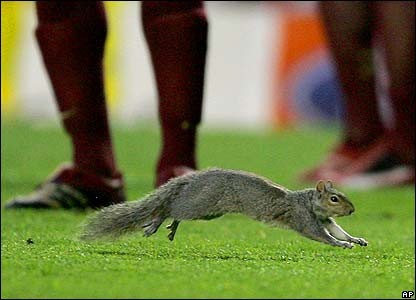
L’anecdote de la soirée c’est l’invasion du terrain par un animal à poil. Non, pas un ‘striker’, mais un écureuil (photo trouvée par JC). Vous savez peut-être que les écureuils pullulent à Londres. Ainsi qu’à New York d’ailleurs - je n’ai jamais compris pourquoi Paris est la seule grande capitale totalement dépourvue d’écureuils. J’en vois tous les jours dans mon patio, mais en 10 ans de foot anglais, c’est la première fois Arsène en voyait sur un terrain pendant un match.

On a laissé l’écureuil gambader quelques minutes sur la pelouse légendaire, jusqu’à ce qu’il sorte de lui même du terrain. Ici en Angleterre on ne ferait pas de mal à un animal à fourrure (ou alors avec une meute de chien). Toute tentative de l’attraper aurait été vaine, de toutes façons, et aurait ridiculisé le candidat – même Thierry n’est sans doute pas assez rapide pour attraper un écureuil. J’ai souvenir de matchs de rugby ou les agents de stade faisaient pendant 5 minutes la joie du public en essayant lamentablement d’attraper un poule ou un coq lâchés par les supporters français.

Fabulous animals
La vie en Angleterre est assez riche en anecdotes urbaines-animalieres. Avant le cute little squirrel at Highbury, on avait eu l’épisode de la cute big whale dans la Tamise l’hiver dernier ; elle on avait réussi à l‘attraper pour essayer de la remorquer vers la mer mais la pauvre était morte d’épuisement dans l’opération. Aussi, il semble qu’il n’est pas rarissime de voir un renard dans les jardins ou dans la rue.

US go home
Pour finir l’écureuil londonien est-il vraiment si cute? Savez-vous que l’écureuil gris qu’on voit partout ici est un écureuil nord américain (le ‘p'tit gris’ des québécois), qui a débarqué a Londres et chassé sans merci son prédécesseur endémique l’écureuil roux? Ce dernier ne survit plus en Angleterre que dans quelques forets reculées. Pensez-y la prochaine fois que vous donnerez des biscuits aux tic et tac de Londres.

1 avril 2006

brit foot - highbury avant fermeture


Sujet : racontez une journée au stade

Introduction
Premier avril 2006. The Fool’s day. Cet après-midi, pour la première et la dernière fois de ma vie j’ai pris place dans les tribunes de Highbury. Pour la dernière fois parce que le mythique stade d’Arsenal va être détruit d’ici quelques semaines, dès la fin de la saison en mai. Je ne remercierai jamais assez Teun de nous avoir trouvé des places. My dream-come-true comme on dit à la télé-réalité. C’était peut-être aussi pour moi la seule et unique occasion de voir Thierry Henry sous le maillot d’Arsenal FC – car comme chacun sait, il risque de quitter le club à la fin de la saison. Bref pour moi tout cela valait la somme assez conséquente que j’ai déboursée, et que je ne dévoilerai pas par décence (cf. ma conversation avec le chauffeur de taxi raconte sur ce blog). Un indice : ça m’est revenu à une livre par minute de match.

Développement
Je passe rapidement sur le match lui même parce que bon, tout le monde n’aime pas forcement le foot. L’équipe qui avait battu la grande Juve quatre jours plus tôt n’a eu comme prévu aucune difficulté pour infliger un 5-0 a Aston Villa (16eme du Championnat). Lehmann, Touré, Senderos, Flamini, Eboué a l’arrière, Gilberto, Pires, Fabregas, Reyes au milieu, Adebayor et Henry devant. Campbell, Ljungberg et Ashley Cole sont toujours blesses. Buts d’Adebayor et Henry en première mi-temps. Dès les premières secondes de la deuxième mi-temps, long ballon vers l'avant, remise en retrait du talon d’Adebayor pour Henry seul à vingt mètres ; Henry enroule le ballon de l’intérieur du pied droit pour l’expédier dans la lucarne opposée. But classique de Thierry, toujours ‘chirurgical’ dans cette position (cf. Irlande-France entre cent autres). Puis Arsène Wenger sort Henry pour l’épargner en vue du match retour contre la Juve. Il le remplace par van Persie qui revient de blessure et marque un but splendide après quelques minutes seulement sur la pelouse. Enfin Diaby, qui a remplacé Fabregas, marque le cinquième but.
Pour l’occasion, j’ai acheté le matin même, et pour la première fois de ma vie, un appareil photographique et j’ai réussi à le faire fonctionner. Comme on était très bien placés (merci Teun), j’ai pu prendre par exemple une photo de Titi attendant tranquillement un ballon près de la ligne médiane, dans son attitude typique et nonchalante de fauve au repos (mais prêt à bondir).

Higbury mon amour
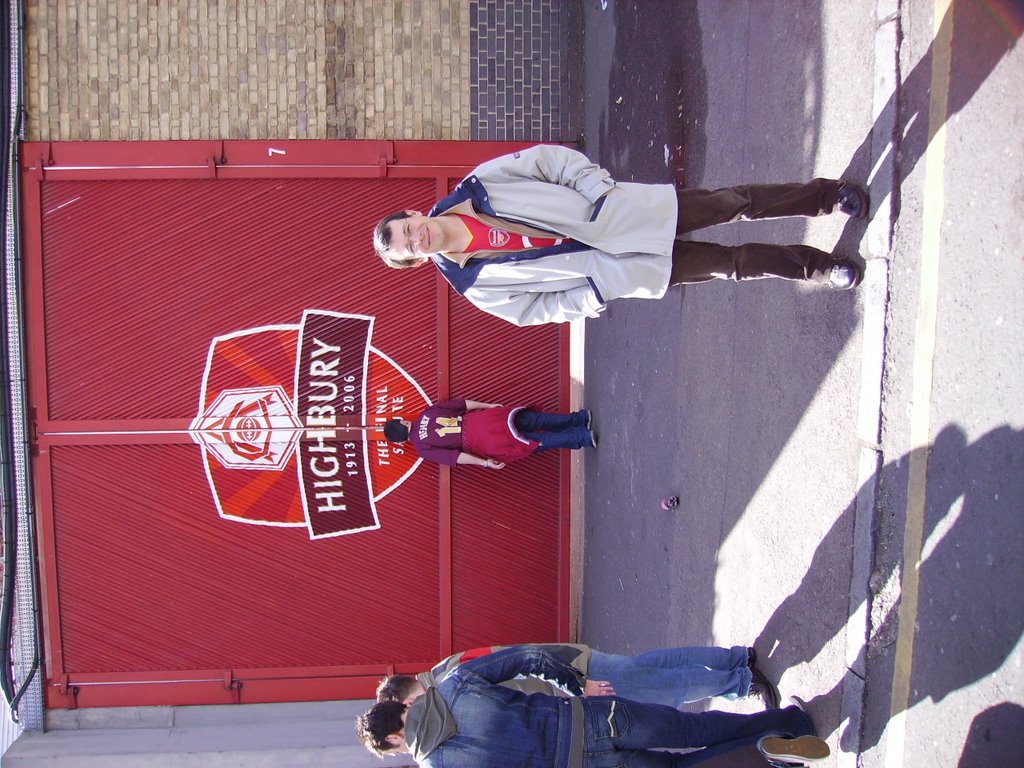
On comprend la nostalgie des vieux supporters et leur tristesse de devoir quitter ce stade vieillot, cosy, bourré de 93 ans d’histoire. Contrairement aux stades modernes de style soucoupe-volante-béton-acier-posées-sur-terrain-vague (Stade de France) il n’y a ici aucune aire d’approche et on ne peut le voir nulle part dans son ensemble. Parce que le stade fait partie du quartier. C’était un terrain de sport dans le village d’Islington autour duquel on a progressivement construit des tribunes en brique et en bois. C’est pourquoi aujourd’hui le stade est serti au milieu des maisons dans ce quartier d’habitation près du métro du même nom. A part l’entrée principale, les autres entrées ne sont des trouées entre les maisons environnantes. Partout est proclamé ‘Arsenal 1913-2006 The Final Salute’ avec la couleur grenat et or d’un ancien maillot commémoratif. Moi je portais – et je porte encore – le classique maillot rouge et blanc, cadeau de Delphine – merci Delphine. Dans l’escalier des tribunes, une photo du Arsenal-Tottenham 1934. 68,000 spectateurs ce jour là. Les Spurs avait gagne mais Arsenal avait tout de même remporté le titre. Je suppose qu’à l’époque la plupart des places étaient debout, ce qui est interdit aujourd’hui pour des raisons de sécurité. C’est pourquoi le stade aujourd’hui ne peut pas contenir beaucoup plus que les 38,000 personnes que nous étions aujourd’hui. Et c’est pourquoi on a construit le Emirates Stadium à Ashtonbury, qui contiendra 65,000 places.

Ce que vous avez le plus adoré
Ce que j’ai le plus adoré c’est l’ambiance familiale et bon enfant qui règne dans les tribunes. Les chansons, la joie. Si vous êtes allé un jour au Parc des Princes – ce que je vous déconseille de faire – vous savez qu’il n’y a que des hommes, dont une forte proportions de connards excités et frustrés. Ici pas de virages ‘ultra’, pas de dichotomie entre les ultras parques dans les coins et le reste du public un peu ‘touriste’, silencieux, qui a un peu peur des connards. Ici pas de problème de hooligans, aucune agressivité envers les supporters ou joueurs visiteurs (sauf Tottenham pour être honnête), aucunes insultes envers les arbitres. Juste l’amour du foot et de l’équipe. Pas de fosse ou de grillage entre la pelouse et les tribunes, juste deux mètres de gazon – les premiers rangs sont à trois mètres des joueurs. La plupart des places sont réservées aux abonnés, souvent des familles : pères, mères, adolescentes, enfants, couples de jeunes, papys. Ici le football c’est l’après-midi ; c’est une sortie familiale. Et la ou nous étions, la gentrification n’a pas encore trop frappe – le public reste en majorité populaire.

Conclusion
J’ai acheté le programme-souvenir bien sûr, avec Fabregas en couverture. Numéroté 01810. On y apprend de belles histoires sur l’histoire centenaire du club. Le 4-4 contre Tottenham le 15 octobre 1963, avec (comme tu le sais Manu) deux buts d’Eastham, un de Baker et un de Strong. On nous propose d’acheter un foot square de la pelouse légendaire pour 25 pounds. On apprend que les Arsenal Ladies sont toujours en tête de la FA women’s Premier malgré leur défaite contre Charlton Athletic. Plein d’autres choses encore. De l’histoire et du marketing. A la fin du match le speaker a annonce que Newcastle a battu Tottenham 3-1. (Maman, Tottenham c’est le quartier voisin d’Islington et c'est l’ennemi héréditaire d’Arsenal FC - leur stade est à deux kilomètres a l’Est). Arsenal revient cinquième au classement a deux points de Tottenham et un match de moins. Je vais peut-être finalement m’acheter un bout de pelouse pour mon petit jardin….

29 mars 2006

brit foot - one old lady, two old men, and young guns (ENG)

On my way to Heathrow and Rome monday I had the most charming and touching chat with an old cab driver, huge Arsenal fan.

‘-Where are you from?
-Isn’t it obvious?
-No. (and here I feel very flattered and decides a generous tip - maybe he was lying)
- I am afraid I am French
- Don’t be ashamed, you beat us in rugby, won the tournament.
- I am not so much into rugby. More a football fan.
- Arsenal huh?’

And there we go. He was sad and sorry that they are going to destroy Highbury and build yuppie flats instead. He fears with the new stadium it will become even more expensive for 'ordinary people' - the real supporters - to get tickets. Many executive lounges in the new stadium you know. Because of executive guys like us... But he wasn't bitter, nice man. I was French, I was wearing a suit and earning the kind of money that raises prices for rents and football tickets in London, and still he was nice to me, contrary to anti-French stereotypes. But as an Arsenal fan you can't be anti-French, can you?

24 hours later on tuesday evening I watched Arsenal v. Juventus in a bar on Via Nazionale in Rome. Little interest for the game in the bar. Roman did not really care, I surveyed cab drivers. There was a bunch of Chelsea jerks who did not give a shit either.

Despite their name, Juventus was overwhelmed by Arsenal’s Youth in its full glory (2-0). Again Fabregas (18) was just magnificent. One paper headlined ‘Who needs Vieira?’ Fabregas makes a terrific season and seems to raise his game when playing the best European teams, how promising! Highly symbolic moment when Pires tackled Vieira, passed to Henry who transmitted to Fabregas, who scored first goal.
Also very warm and moving welcoming from Highbury Vieira at the start.

Henry was fantastic in second half. Drove them mad. Camoranesi and Zebina lost their nerves and Juve finished with nine players. Sadly, Vieira received a yellow card that will deprive him from second leg.

Near to me was a lonely old tiffoso of the Old lady, very dignified gentleman. I felt a bit sorry for him after second goal but young guns were just too good yersterday.

At least another old man was happy back in London.

27 mars 2006

telly for dummy - hype definition (ENG)

Whilst technology is set for the launch of high definition (HD) services in Europe, the consumer appeal remains a big question mark. Do we really want higher quality? In consumer studies, people always say they want ‘picture quality’ above all, but the success of flat panel TV has nothing to do with picture quality.
Actually, LCD and plasma display technologies, although continuously improving, are still way behind the good old CRT technology on several quality criteria (colour, contrast, brightness, viewing angle, response time). But people don’t care, they go for flat. Slim, designer 16:9 flat panel TV are trendy, must-have gadgets, and the best ever argument given to husbands helping them convince their wives into buying a new, big TV before an upcoming football World Cup. Dad’s telly is no longer an ugly bulky box—and housewives can spare precious square feet for the replacement.

What does history tell us about quality? Was VHS a better format than Betamax? Of course not. Did CD and DVD succeed because of their better sound or their higher usability? Probably more of the latter. What became of SACD, once promoted as a ‘high definition’ music format? A complete failure. Instead consumers fell in love with a low-quality yet portable format: MP3. Many examples show that ‘superior quality’ per se is not a guarantee of success. People love it in theory but are not always able to recognise it, let alone pay for it. And design or flexibility are often a more powerful driver. Samsung is launching high definition CRT models in Europe. Though a little thinner than traditional CRTs and much cheaper than flat-panel display, we don’t expect them to become more than a niche category.

Besides, can we tell high definition television when we see it? Can we detect the difference between standard definition (SD) and HD? The theoretical answer is yes. It has been said that whilst HD is a big quality leap in the US NTSC context, the HD improvement would be barely visible in a PAL/SECAM European environment. But our visual accuity can allow us to see tinier details than the pixels of a PAL image on an SD
screen viewed from a typical distance. Lab trials showed that on a 37-inch screen or above we can see the difference between SD PAL (576 lines) and HD (720 lines or more). But we are close to visual limits. Beyond 1080 lines any higher definition would result in no perceivable improvement in normal living room television viewing. In practice, in comparative screenings, most consumers would not see a big difference. But, of course, you never watch comparative screening in retail. You just watch an HD source from a demo feed and the result can be breathtaking.

To conclude: the hype about high definition being the biggest thing in television since colour is simply not true. Flat screens or even mobile TV are the bigger things in terms of revolutionising TV consumption. But anyway, whether we are aware of HD or not, whether we want HD or not, the beauty of consumer electronics marketing is that we will get HD-ready sets when migrating to flat panel displays. Then broadcasters and European pay TV operators will have an opportunity to try and differentiate with this feature, just like they are already doing in the US.
And even if the quality improvement is factually small,with time our eye will get used to HD sharpness, in sports and movies. We will watch SD in sports pubs or at friends places, so that within 10 years, SD will suddenly become ‘unwatchable’, and all other genres and channels will have to migrate to HD quality.
The words ‘high definition’ will disappear and HD will become standard television.

9 février 2006

film - Tim Burton's Corpse Bride

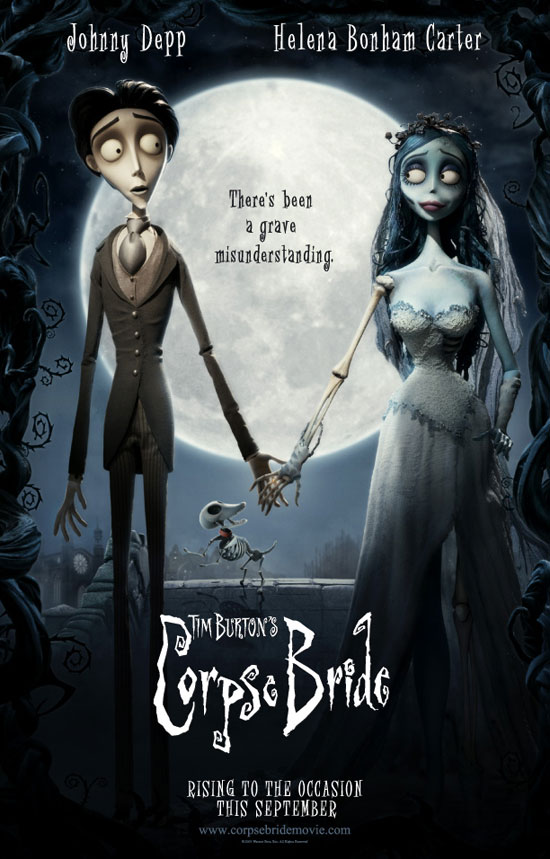
Il était bien difficile d’élire le plus mauvais film de 2005. Entre Star Wars III, La guerre des Mondes et The Island, d'autres encore, les très mauvais films étaient nombreux en lice cette année. Mais absolument aucune hésitation pour le meilleur film de l’année. Tim Burton’s Corpse Bride (Les noces funèbres) de Tim Burton et Mike Johnson est une œuvre qui nous émerveille immédiatement et dont l’importance saute aux yeux des spectateurs vivants.

Bizarrement ce film est passé un peu inaperçu. Porté par très peu de promotion, il a fait un petit million d’entrées en France, auprès des fidèles du Maître, mais je ne l’ai vu mentionné dans aucun palmarès de journaux, nommé dans aucun prix. Sans doute trouve-t-on normal que Tim Burton produise un nouveau chef d’œuvre tous les deux ou trois ans.

Pourquoi cela ? Eh bien l’habituel ostracisme dont sont victimes les films d’animation. Les critiques préfèrent toujours le filmage des chairs et des os d’acteurs vivants. Les dessins et les marionnettes, n’est-ce pas, sont des jeux pour les enfants. Et puis peut-être le racisme anti-morts qui sévit chez les critiques vivants. Une variante de jeunisme sans doute. Les habitants des enfers en revanche auront sûrement beaucoup apprécié les blagues sur les vivants. Mais peu importe la reconnaissance des vivants.

Une autre raison aussi : la parenté de ce film avec The Nightmare before Christmas (L’étrange Noël de Monsieur Jack), réalisé il y a déjà dix ans par Tim Burton. Même technique, même univers gothique, même compositeur. The Nightmare est sans doute le plus beau film d’animation de l’histoire du cinéma. Il était pratiquement impossible de faire aussi bien et quand bien même ce serait aussi bien, nous avons plus la surprise et le choc esthétique que constituait L’Etrange Noël.

On ne peut pas éviter la comparaison, alors autant y aller franchement. A la revoyure en DVD, ce soir, je pense maintenant que Corpse Bride est tout aussi important que L’étrange Noël.

La technique, donc, reste la même : marionnettes et ‘stop motion’ (image par image). Mais la fluidité, les mouvements d’appareils et la lumière sont encore beaucoup plus fluides et plus beaux que ceux de l’Etrange Noël. Rien que pour la beauté de ses textures et de sa lumière, Corpse Bride est un émerveillement.

La musique et les chansons de Danny Elfman, entre Cab Calloway et Kurt Weil sont presque aussi chouettes que celle de l’Etrange Noël. L’idée d'origine - Orphée a l'envers - est charmante. La mort lui va si bien. Le scénario, la narration sont merveilleusement simples et limpides. Alors que tant de films aujourd’hui, bons ou mauvais, s’étirent sur deux heures, deux heures trente, trois heures, Corpse Bride dure une heure et dix minutes. C’est d’ailleurs un peu frustrant. Quand il tient un moment de grâce comme la scène de piano à quatre mains entre Victor et la Corpse Bride, alors qu’on est sous le charme, on passe à une autre scène. Aucune instant ou dialogue inutile, aucun ornement, aucune enflure. Un Peter Jackson vous assène trois tyrannosaures et un troupeau de brontosaures quand un gorille miniature aurait suffit. J’ai lu dans une interview que Jackson avait eu la vocation du cinéma grâce au premier King Kong et à Ray Harryhausen (le légendaire animateur de Jason et les Argonautes). Je pense, moi, que Jackson ne comprend rien au monde des marionnettes et que le vrai héritier de Georges Méliès et de Ray Harryhausen c’est Tim Burton. (D’ailleurs amusez-vous à chercher les clins d’œil à Harryhausen cachés dans le film).

Corpse Bride n’a pas la folie baroque de l’Etrange Noël. Sa beauté visuelle est plus retenue; romantisme n’en est que plus flamboyant. Et contrairement à tant de film poétiques-romantiques - y compris peut-être Big Fish - qui flirtent dangereusement avec le mélodrame sentimental, Corpse Bride reste sec, romantique et léger à la fois, émouvant sans être mélo. La marionnette de l’adorable cadavre, inspirée du beau visage triste d’Helena Bonham Carter, nous touche infiniment avec ses grands yeux confiants et sa naiveté. On songe aux fiancées tragiques des contes de Poe, on songe à la noyée de la Nuit du chasseur, on songe à l’Ophélie flottante de Millais. On songe à Pensées des Morts de Lamartine.

Site officiel du film