A best seller in the UK, this American book by young economist Steven Levitt is quite entertaining. No big picture theory on inflation, growth or trade – Levitt is much more into micro-economics, individual economic behaviour and more specifically, how we respond to incentives. Lots of counter-intuitive outcome from economic anecdotes. Once a kindergarten decided to start charging $2 parents who pick up their kids late, and guess what happened? Well there were more parents coming late. Why that? Because a $2 penalty on top of a $50 monthly fee is too small to be a deterrent AND the penalty freed parents from any sort of embarrassment or guilt – they would not try their best to come on time any more. Carers are paid for the extra time waiting for late parents aren’t they, so why worry? The most ironic bit is that when the fee was finally cancelled, the late rate did not come to what it was previously but grew even higher. Parents had lost the sense of obligation they used to have and now it was without financial consequence anyway. The lesson? Unless you are ready to create significant monetary incentive, keep the moral incentive that works.
The most interesting part is the story of this young student economist who spent years hanging around with a Black drug gang in Chicago for years. Because the local boss was an educated man before turning a thug, the student had serious business discussions with him; ultimately he also accessed the full accountability of the gang for five years. Local gangs in Chicago work like franchises. A ‘Board of Directors’ of 12 big bosses gives the monopolistic licence for crack dealing in a given neighbourhood in exchange of a 30% of revenues. Just like white upper class is mimicking Black ‘gangsta’ looks, real gangsters like to mimic white corporate America. The gang accounting showed that only the local boss makes good money ($150,000 per year) while – contrary to conventional wisdom - the many ‘foot soldiers’ hardly make a living. Far from driving fancy cars, they usually live at their mother’s. And they take enormous risks. One chance out of five to get killed by a rival gang, one chance out of two to go to jail, in a period of five years. So why in the world would you want to become a drug dealer? Simply because you have a chance to become a boss if you are good and lucky. Although the probability to become one is very small and does clearly not the risk, young unqualified boys try their chance, just like pretty Wisconsin farm girls go to Hollywood – nothing rational in it, just an act of faith.
Affichage des articles dont le libellé est books. Afficher tous les articles
Affichage des articles dont le libellé est books. Afficher tous les articles
2 septembre 2007


18 août 2007
Imperium, par Robert Harris
Je vous recommande le nouveau roman historique de Robert Harris, Imperium. C’est, racontée par son esclave/conseiller/scribe Tiro, l’histoire haletante de la première partie de la carrière de Cicéron, l'ascension d’un pauvre avocat de province, pas même noble, jusqu’au sommet de l’Etat. Tiro nous raconte trois épisodes en particulier :
• Le procès Verres. En 70, le jeune sénateur Cicéron attaque l'ex gouverneur de Sicile, pourtant soutenu par toute l’aristocratie, défendu par son grand rival du barreau l'avocat Hortensius, dans un procès où le jury était acheté par Verres. L’éloquence de Cicéron et l’amoncellement des preuves de corruption pousse Verres à l’exil avant même le prononcé du jugement. La victoire de Cicéron lui assure une énorme popularité et une place sur le banc des sénateurs patriciens.
• Le coup de Pompée. Haï par les sénateurs patriciens, détesté par le millionnaire Crassus, Cicéron pour survivre est obligé de se rallier à Pompée. Il lui assure un Triomphe et lui fait obtenir des pouvoirs militaires extraordinaires pour lutter contre les pirates (les terroristes de l’époque). Cicéron n’aime pas les militaires mais il manigance tout cela, à contrecœur, pour neutraliser ses ennemis et pour devenir Préteur (dernière étape avant la magistrature supreme, Consul). Mais ce faisant, il crée un précédent participant à l’affaiblissement des institutions civiles qui finira par le tuer, lui, et tuer la République vingt ans plus tard.
• La campagne pour le poste de Consul en 63. Par un coup de génie, Cicéron réussit à se faire élire consul contre la conjuration et les millions de Catilina, Hybrida et Crassus.
Cicéron est évidemment le good guy de l’histoire. Le démocrate, le pacifiste, l’intellectuel, le réformateur, l'incorruptible. L’underdog devant naviguer constamment entre trois factions également puissantes qui toutes le méprisent et le traitent de 'parvenu' : le parti des aristocrates patriciens (Caton, Catulus, Hortensius, Lucullus, Catilina…), les millionnaires populistes mafieux (Crassus) et les grand généraux toujours un peu putchistes (Pompée, César). Cicéron, lui, n’a ni un grand nom (son père n’était pas noble mais un simple chevalier), ni fortune (seul son mariage avec une fille de patricien lui permet d’emprunter le million de sesterce nécessaire pour se présenter au Sénat), ni la gloire militaire et la loyauté des vétérans, qui assurent un ‘fast track’ vers le sommet.
Face à cela, ses armes à Cicéron étaient d’un genre nouveau : la loi et la voix.
Sa connaissance de la loi et de la jurisprudence en matière judiciaire et constitutionnelle, en cette fin de République, était une arme efficace, car même les politiciens les plus corrompus se sentaient contraints de respecter les nombreuses formes légales et traditions républicaines.
Son éloquence d’un genre nouveau, faisait appel à l’intelligence et à l’humour de l’auditoire, et plus seulement à la rhétorique théâtrale de la génération précédente. Cicéron appliqua avec succès l’éloquence judiciaire et législative à ses campagnes de terrain, à ses discours au peuple. Et pas seulement le petit peuple de Rome. Profitant du fait que le corps électoral en ces années vient d’être étendu à certaines provinces reculées de l’Italie, il n’hésite pas, fait inouï, à partir en campagne électorale dans ces contrées pendant que ses adversaires se livrent à des enchères pour acheter les voix des quartiers et centuries de Rome. Bref Cicéron était le premier politicien moderne. Il n'est pas non plus un idéaliste naif. S'il défend les citoyens de Sicile contre l'infâme Verres, pour se faire un nom, il va ensuite défendre un gouverneur de Gaule tout aussi corrompu que Verres, parce que les circonstances ont changé. Et, comme tout politicien moderne, il passe son temps à faire de alliances et des compromis secrets, bancals, voire dangereux. Mais il reste républicain, c'est à dire démocrate et partisan des voies légales.
Alternant les campagnes électorales et les procès, les conspirations et les coups de théâtre, le récit de Tiro/Harris est le synopsis parfait pour un thriller juridico-politique hollywoodien. Je ne suis pas certain qu’il soit en tout point conforme à la réalité historique ; par exemple je ne suis pas sur que César et Crassus aient été aussi clairement impliqué dans la conspiration de Catilina et la manière dont Cicéron déjoue le complot est probablement romancée.
Very good read. Very easy in English, by the way.
One review by The Guardian
• Le procès Verres. En 70, le jeune sénateur Cicéron attaque l'ex gouverneur de Sicile, pourtant soutenu par toute l’aristocratie, défendu par son grand rival du barreau l'avocat Hortensius, dans un procès où le jury était acheté par Verres. L’éloquence de Cicéron et l’amoncellement des preuves de corruption pousse Verres à l’exil avant même le prononcé du jugement. La victoire de Cicéron lui assure une énorme popularité et une place sur le banc des sénateurs patriciens.
• Le coup de Pompée. Haï par les sénateurs patriciens, détesté par le millionnaire Crassus, Cicéron pour survivre est obligé de se rallier à Pompée. Il lui assure un Triomphe et lui fait obtenir des pouvoirs militaires extraordinaires pour lutter contre les pirates (les terroristes de l’époque). Cicéron n’aime pas les militaires mais il manigance tout cela, à contrecœur, pour neutraliser ses ennemis et pour devenir Préteur (dernière étape avant la magistrature supreme, Consul). Mais ce faisant, il crée un précédent participant à l’affaiblissement des institutions civiles qui finira par le tuer, lui, et tuer la République vingt ans plus tard.
• La campagne pour le poste de Consul en 63. Par un coup de génie, Cicéron réussit à se faire élire consul contre la conjuration et les millions de Catilina, Hybrida et Crassus.
Cicéron est évidemment le good guy de l’histoire. Le démocrate, le pacifiste, l’intellectuel, le réformateur, l'incorruptible. L’underdog devant naviguer constamment entre trois factions également puissantes qui toutes le méprisent et le traitent de 'parvenu' : le parti des aristocrates patriciens (Caton, Catulus, Hortensius, Lucullus, Catilina…), les millionnaires populistes mafieux (Crassus) et les grand généraux toujours un peu putchistes (Pompée, César). Cicéron, lui, n’a ni un grand nom (son père n’était pas noble mais un simple chevalier), ni fortune (seul son mariage avec une fille de patricien lui permet d’emprunter le million de sesterce nécessaire pour se présenter au Sénat), ni la gloire militaire et la loyauté des vétérans, qui assurent un ‘fast track’ vers le sommet.
Face à cela, ses armes à Cicéron étaient d’un genre nouveau : la loi et la voix.
Sa connaissance de la loi et de la jurisprudence en matière judiciaire et constitutionnelle, en cette fin de République, était une arme efficace, car même les politiciens les plus corrompus se sentaient contraints de respecter les nombreuses formes légales et traditions républicaines.
Son éloquence d’un genre nouveau, faisait appel à l’intelligence et à l’humour de l’auditoire, et plus seulement à la rhétorique théâtrale de la génération précédente. Cicéron appliqua avec succès l’éloquence judiciaire et législative à ses campagnes de terrain, à ses discours au peuple. Et pas seulement le petit peuple de Rome. Profitant du fait que le corps électoral en ces années vient d’être étendu à certaines provinces reculées de l’Italie, il n’hésite pas, fait inouï, à partir en campagne électorale dans ces contrées pendant que ses adversaires se livrent à des enchères pour acheter les voix des quartiers et centuries de Rome. Bref Cicéron était le premier politicien moderne. Il n'est pas non plus un idéaliste naif. S'il défend les citoyens de Sicile contre l'infâme Verres, pour se faire un nom, il va ensuite défendre un gouverneur de Gaule tout aussi corrompu que Verres, parce que les circonstances ont changé. Et, comme tout politicien moderne, il passe son temps à faire de alliances et des compromis secrets, bancals, voire dangereux. Mais il reste républicain, c'est à dire démocrate et partisan des voies légales.
Alternant les campagnes électorales et les procès, les conspirations et les coups de théâtre, le récit de Tiro/Harris est le synopsis parfait pour un thriller juridico-politique hollywoodien. Je ne suis pas certain qu’il soit en tout point conforme à la réalité historique ; par exemple je ne suis pas sur que César et Crassus aient été aussi clairement impliqué dans la conspiration de Catilina et la manière dont Cicéron déjoue le complot est probablement romancée.
Very good read. Very easy in English, by the way.
One review by The Guardian
26 mai 2007
Fermat's Last Theorem, par Simon Singh

J’ai déjà parlé ici de Big Bang de Simon Singh, voici Fermat’s Last Theorem. Exactement comme dans Big Bang avec la cosmologie, Singh fait un roman policier à suspense avec l’histoire des mathématiques.
Ça démarre vraiment comme une crime story. En 1993 à Cambridge, le mathématicien anglais Andrew Wiles stupéfie le monde en faisant, durant un colloque, au tableau, la démonstration du théorème de Fermat qui échappait à tous les plus grands mathématiciens depuis plus de trois cent ans.
En 1637, le mathématicien toulousain Pierre de Fermat écrivit dans la marge de son examplaire du Arithmetica de Diophante la proposition suivante :
Soit x, y et z trois nombres entiers. Soit n un nombre entier.
Si n est supérieur ou égal à trois, il n’existe pas de solution à l’équation :
z(n)= x(n) + y(n)
Et Fermat ajouta négligemment, en latin, la notation suivante : ‘j’ai trouvé une démonstration magnifique à ce théorème mais je n’ai pas la place de l’écrire ici’. Fermat était comme ça, un génie amateur, dilettante et arrogant. Par tempérament et par nécessité (son emploi de clerc au Parlement de Toulouse), Fermat avait en permanence des intuitions géniales mais ne prenait jamais le temps de les développer ; il jetait juste les bases de ses démonstration et mettait au défi les autres grands mathématiciens – souvent riches et oisifs - de compléter. Il était le McEnroe des maths au XVIIème siècle ; il rendait fous de rage tous ses collègues européens avec qui il correspondait.
La fascination rapidement exercée par le théorème de Fermat, au-delà du milieu des mathématiciens professionnels, provient de l’extrême simplicité de son énoncé (qui suggère intuitivement une démonstration simple elle-aussi), et du défi mystérieux derrière la notation de Fermat (j’ai trouvé la solution mais je ne vous la livrerai pas). Tous les plus grands génies des trois siècles suivants se sont essayé à (re)trouver la solution : Newton, Euler, Gallois, Cauchy, Lamé, Kummer etc. Le problème est devenu encore plus mythique lorsque des mathématiciens amateurs et riches ont commencé à promettre des prix substantiels à qui trouverait le Graal des maths : en 1908 l’allemand Paul Wolfskehl laissa par testament une somme de 100 000 marks (environ 700 000 euros d’aujourd’hui) à qui trouverait une solution dans les cent prochaines années.
La résolution du théorème de Fermat était donc à la fois un exploit sportif, une conquête et une (re)découverte : l’Everest, le Pole Sud, le Saint Graal et le trésor des Incas. Un merveilleux sujet de bouquin. Nous sommes bien dans le domaine du sport, de l’inutile, car la résolution du théorème n’a aucun intérêt scientifique ou mathématique majeur. Il a été prouvé des le XIXème siècle que le théorème était vrai pour la plupart des nombres premiers et, partant, pour pratiquement toutes les valeurs de n. Apres 1945, les ordinateurs ont calculé qu’il était vrai pour des milliards de valeurs de n, mais, bon il restait à démontrer qu’il était vrai pour TOUTE valeur de n.
Le théorème de Fermat est un merveilleux sujet en lui-même mais aussi le prétexte parfait pour une histoire amusante et passionnante de l’arithmétique et de la théorie des nombres en particulier. On y redécouvre beaucoup de propriétés merveilleuses des nombres premiers. Par exemple saviez-vous que Pythagore avait fondé une sorte de secte secrète d’adorateurs des nombres, et qu’il fit mettre à mort un disciple qui avait osé suggérer l’existence de nombres irrationnels (qui ne peuvent s’écrire sous la forme d’une fraction de nombres entiers). On y redécouvre certaines des démonstrations les plus élégantes comme la démonstration par Euclide que la racine de deux est précisément un nombre irrationnel. On se replonge dans l’invention des nombres imaginaires (je me souviens encore de mon émerveillement quand on nous a révélé la solution de x2=1, le nombre imaginaire pur i). Bref le bouquin nous promène depuis les grecs jusqu’aux mathématiciens contemporains pour nous expliquer, étape par étape l’apparition des principaux concepts qui ont conduit à la proposition de Fermat et les principales branches des maths qui ont après lui, essayé de le résoudre. Singh sait raconter avec clarté et divertir le lecteur avec des anecdotes sur la vie des grands génies, comme le tragique et romantique destin d’Evariste Gallois (le James Dean, le Jimmi Hendrix des maths).
Mais revenons à Wiles. Ce jeune type, après deux ans passées reclus à chercher secrètement la solution, accède du jour au lendemain à la gloire des grands découvreurs et des grands sportifs. Il rejoint Bob Beamon et Roald Amundsen. Après son triomphe à Cambridge, Wiles livre un manuscrit de 60 pages aux journaux mathématiques qui affectent, simple routine, une demi-douzaine de mathématiciens de diverses spécialités pour examiner et confirmer la démonstration, étape par étape, avant publication. Et c’est le drame, car l’un d’entre eux découvre une petite faille, un maillon faible dans la logique de Wiles. Wiles admet le problème et pense pouvoir le résoudre en quelques jours, mais il s’avère que la faille est fondamentale et détruit la validité de sa preuve. Tout s’écroule. Mais, comme dans un roman, Wiles se remet au travail avec ses collaborateurs pour contourner le problème et tenter d’atteindre véritablement le sommet de la montagne.
Je ne vous dirai pas ici si Wiles a finalement franchi les derniers mètres et réussi à prouver la conjecture de Fermat, car je ne le savais pas moi-même et le suspense participe évidemment au plaisir du livre.
Mais que Wiles ait trouvé ou non la solution, le mystère demeure : Fermat avait-il vraiment trouvé une solution de son coté ou était-il juste en train de se vanter ?
Disons simplement, qu’étant donné la longueur et la complexité de la démonstration de Wiles, empruntant aux concepts et aux constructions les plus sophistiquées des maths du XXème siècle, il est absolument impossible que Fermat ait développé une démonstration similaire. Il parait aussi à peu près impossible qu’il ait trouvé une autre solution avec les outils rudimentaires de l’arithmétique du XVIIème siècle, et que personne d’autre n’aurait retrouvé après lui. Mais il est tentant et romanesque d’imaginer qu’il a griffonné une solution fulgurante au dos d’un carnet disparu…
----------
Il faut absolument que vous fassiez lire ce bouquin à vos gamins, à partir de 13-14 ans je dirais. Ce petit bouquin passionnant (et facile en anglais) leur apprendra que les maths c’est de l’art, c’est un jeu, c’est un sport, c’est fun, s’ils n’ont pas eu la chance de tomber sur un prof qui leur a fait aimer les maths.
Un autre bouquin sympa sur les maths à faire lire aux ados, c’est Le Théorème du Perroquet de Denis Guedj, une petite histoire policière à la Pennac qui elle-aussi nous entraîne dans la fascinante histoire des nombres.
Le site Simon Singh
13 mai 2007
'big bang' by Simon Singh

This history of cosmology and the successive views of the cosmos, is one of those books I would have loved to read between say 12 and 14 years-old – but I can still enjoy them very much now.
It is lots of fun and fascinating anecdotes. It explains in the clearest way the most complex astronomical and physics theories. At another level it is full of interesting epistemological observations on why one theory is believed and one is not, what is good science and bad science (eg all things being equal the simplest explanation is likely to be the right one), how the different paradigms follow each others, how one finally supersedes another one, how theory and observation complement each other, how astronomy and physics interacted in the XXth century.
Like he did with the most famous math problem in the equally fascinating Fermat’s Last Theorem, Simon Singh builds a very entertaining and well-structured crime story on the Big Bang cosmological model.
We have this ugly word in French ‘vulgarisation’ to refer to what Anglo-Saxons call ‘popular science’ although the French astronomer Camille Flammarion one of the first to write popular books on science in the late 1800s (although he may have discredited himself to the eyes of fellow scientist and therefore undermining popular science by also publishing works of science fiction and on spiritism).
Talking of popular science, the BBC has just celebrated the 50th anniversary of the astronomy programme ‘The Sky at Night’ which was first presented by the serious-but-relax Churchillian-looking astronomer Sir Patrick Moore in 1957 and still a weekly show today. It is believed it did a lot to keep popular science culture and scientific studies alive in the UK, I am afraid I cannot mention one French programme on astronomy or any other popular science subject in prime time hours. The only one I can think of, by the ridiculous brothers Bogdanoff, was mixing science and science fiction and stopped many years ago anyway.
Early astronomical discoveries are amazing by their simplicity. Armed with good sense, good reasoning, a little observation of simple facts, and the most basic trigonometry concepts, and a tool to measure angles accurately, a 11-years-old squad can re-do the line of reasoning that led ancient Greeks to calculate, with 10% accuracy:
• The circumference and diameter of the Earth (Eratosthenes and the well of Assuan)
• Then the diameter of the moon (as it crosses the shade of Earth)
• Then the distance of the moon
• Then the distance of the sun
• Then the size of the sun
How come we don't get to do that in class?
Successive paradigm on the shape of the universe
1. Earth-centred model. Fixed Earth at the centre of the universe (Ptolemy model made the official catholic paradigm)
2. Sun-centred model. Sun at the centre of the universe, Earth spinning and orbiting around the sun, the star still being a fixed background (voute céleste) (Copernicus, Kepler)
3. Milky Way. Sun being part of a group of similar stars, hence no longer the centre of a fixed celestial sphere (Herschel, 1700s).
4. Modern Universe. In 1923 US Astronomer Edwin Hubble demonstrates that nebulae are not within the Milky Way but are instead other galaxies in their own right, far beyond the Milky Way, thus ending ‘The Great Debate’.
10 fun facts about cosmology
1. Among ancient civilisation, Babylonian and Egyptians were technologists, as were Romans later. But Greeks invented Science, the contemplation of nature and the sake of knowing it understanding natural phenomena and laws. In the field of astronomy, Babylonian and Egyptian were fantastic observers in order to establish calendars and astrology predictions; but their cosmology views was stuck by religious beliefs. Aristarchus of Samos (born 310 BC) first developed a heliocentric model putting all planets in the correct order of orbiting, but it was rejected for being contradictory to common sense and cosmic myths: if Earth was not at the centre of the universe, how come objects seemed to fall towards the Earth? And if Earth was moving around the Sun, how come we are not blown away by the ‘wind’ this motion would create? Also the model of a fixed Earth in the middle of an outer fixed sphere of fixed stars was felt to better explain the absence of parallax of stars. As a result, Aristarchus and heliocentrism fell into total oblivion for two thousand years. It is now believed Copernicus had some notion of Greek heliocentrism but he did not mention it in his books, maybe by fear of referring to pre-Christian scientists.
2. The Earth-centred system was struggling to explain some astronomical observations like the apparent retrograde motion of planets. To fix that, Ptolemy (90-168 AD) came out with a complicated and bizarre cosmology involving ‘epicycles’ of planets. But it made the trick of being consistent with detailed observations. As a matter of fact, hundreds of year of investing in astronomical observations according to the Ptolemaic model made it increasingly more 'accurate' in predicting terms and too valuable to just throw away. It is one of the drivers of conservatism in science: you are better off and right living with a wrong theory that works, than throw the baby with the water. After all who cares about the real shape of the world when you spent years learning the Ptolemaic canons? Better wrong with Ptolemy than right with those Copernicians punks.
3. The middle-age world, both Christian and Islamic, picked up a few known books from Greek philosophers and scientists - mostly Aristotle and Ptolemy – but sometimes they picked the wrong ones (Ptolemy had also made a huge error in his Geography, by underestimating the circumference of the Earth – which incidentally made Columbus believe he could reach Asia by sailing West). They chose between ancient theories those that seemed roughly compatible with holy books, and made them an article of faith, prohibiting any other ones. No wonder that Copernicus’ De Revolutionibus (1543) was totally ignored – and banned - for decades.
4. Galileo was the first to use lenses and telescopes to observe the sky. Equipped with the best telescope of his time he made many observations that proved Copernicus paradigm: he discovered the moons of Jupiter, proving some objects do orbit other planets than Earth; he proved that the phases of Venus are incompatible with the Earth-centred model but look fully in line with what Copernicus predicted. The book he wrote to support the Sun-centred model – Dialogue concerning the two chief world systems – was all the more dangerous and provocative that it was written in Italian not Latin, and written as a Socratic dialogue to be understandable by anyone with good sense. Although the pope Urban VIII (Maffeo Barberini) was an youth friend of Galileo, the religious politics of the time – the competition from rising Reform – led the Catholics to be ruthless on dogma and conservatism, so Galileo had to recant in 1633 under torture threat.
5. At the beginning of the XXth century, scientists assumed a static, eternal and stable universe. After developing its General Relativity physics (1915), Einstein looked at the cosmological consequences and was horrified to see that it meant gravitational attraction would make the universe collapse. So he tweaked his own beautiful model by introducing the ‘ugly’ (to his own acknowledgment) ‘cosmological constant’ to counteract gravity and keep the universe stable.
6. The concept of a dynamic universe was first developed by theoretician physicists Russian Friedman and Belgian Lemaitre in the early 1920. Lemaitre’s theory was that modern universe evolved from the explosion of a compact, almighty, ‘primeval atom’. Although their models were based on Einstein’s general relativity physics (with the cosmological constant ditched) and compatible with it, Einstein fiercely opposed them, to the point of publicly humiliating Lemaitre – Einstein’s rejection at this point was more than enough to ruin someone’s career. However, after Hubble had observed the recession of galaxies, Einstein showed his greatness by being able to fully apologize to Lemaitre and then endorse the expanding universe theory. He made this extraordinary comment: ‘To punish me for having been such a rebel, fate made me a despot myself’.
7. Studying the spectroscopy of distant stars and galaxies, Hubble in 1929 that the wavelength of the light of most stars are getting longer (redshift), which according to the Doppler effect, means they are moving away from us. In fact the further they are, the faster they race away. It proved the universe is expanding and suggests indeed a primordial explosion (although Hubble himself never indulged into cosmology).
8. Despite this blow, British supporters of the stable universe led by Fred Hoyle came back in the 1940s with the ‘Steady State’: the universe is expanding but new matter is created in between galaxies so that there is no need of a initial explosion to explain motion and matter, and the universe remains eternal and structurally stable. As the fierce academic battle between the two paradigms hits mainstream press, Hoyle derides the expanding universe as a ‘Big Bang’ theory, thus inadvertently giving his opponents a popular label. Some cosmologists also found the big bang suspicious because it looked too much like Bible Genesis and the hand of God – besides it had been first invented by a catholic priest…
9. Meanwhile US physicists Gamow and Alpher developed the big bang paradigm, linking nucleosynthesis, astronomy and cosmology in a elegant and consistent history of the big bang, from a dense hot chaotic plasma of particles to atoms and stars. It explains the relative proportion of hydrogen and helium in modern universe from fusion in the early seconds after big bang, but fails to explain the further synthesis of carbon and heavier atoms. They also predicted that a Cosmic Microwave Background radiation (CMB) may still visible as an echo of the flash that happened 300,000 years after big bang, when electrons are finally captured by nuclei and photons are able to circulate unhindered across matter.
10. Fred Hoyle gave another hand to the big bang theory when he helped overcoming the problem of nucleosynthesis of heavy elements. However the coup de grace came Penzias and Wilson who in 1964 accidentally discovered the predicted CMB when trying to identify the cause of the noise affecting their radio-telescope. The fossil radiation had the exact wavelength predicted by Gamow was indeed coming from every direction of the sky. (Also financed by Bell Laboratories to study on natural radio waves interfering with long-distance communication, Karl Jansky had discovered cosmic radiations in the 1930s).
Simon Singh's website
16 juin 2006
'A short story of tractors in the Ukrainian'
 En France les romans sont d’abord publiés dans des gros volumes très chers avec des couvertures ‘sobres’ et une jaquette prétentieuse, puis quelques mois plus tard dans des collections de poche, beaucoup moins chères. Ici les bouquins paraissent dans un format intermédiaire, et les couvertures sont toujours illustrées. En France on aime bien se moquer des couvertures brillantes, roses, en relief, des romans d’amour d’américains ; encore une preuve de la vulgarité des anglosaxons. C'est vrai que presque tous les livres anglosaxons ont droit à une couverture illustrée, avec, des la deuxieme édition, les éloges des critiques écrit dessus. Cela n’est pas déshonorant, ni pour l’auteur, ni pour l’éditeur de placer un dessin divertissant et coloré en couverture d’une histoire divertissante et colorée. En France on pense qu’un bon livre ou un bon vin n'ont pas besoin d'un emballage attrayant. Chiant est synonyme de bon goût et de qualité.
Tout cela pour dire que c’est la couverture de ce livre qui a attiré mon attention, puis la quatrième de couverture.
Dans ma série ‘petits livres drôles, touchants, courts et faciles à lire en anglais’, après Paasilinna et Mark Haddon (janvier), voici Marina Lewycka.
‘A short history of tractors in the Ukrainian’ ah oui c’est le titre aussi qui m’a plu tout de suite, ça pourrait le titre d’un film de Kaurismaki.
Alors citons-la, la quatrieme de couverture: ‘Sisters Nadezhda and Vera must put aside a lifetime of feuding to save their émigré eighty-four-year-old engineer father from voluptuous gold-digger Valentina. With her proclivity for green satin underwear and boil-in-the-bag cuisine, she stops at nothing in her pursuit of Western wealth, and a British passport. She explodes in their lives like a pink fluffy grenade, churning up the murky water, giving the family ghosts a kick up of the backside’.
Il parait que ça a déjà été traduit dans 27 langues, donc je suppose en français mais croyez c’est super facile et sympa en anglais.
15 janvier 2006
livre - "The curious incident of the dog at night-time"
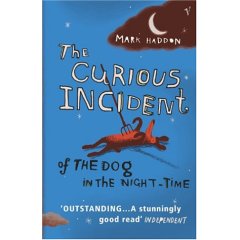 Ce très joli petit livre de Mark Haddon a obtenu le ‘Whitbread Book of the Year’. J’ai tendance à penser que c’est une bonne référence parce que mon roman contemporain préféré Behind de the scene at the museum - dont je vous parlerai prochainement - a aussi reçu ce prix.
The Curious incident est une histoire racontée à la première personne par un adolescent de quinze ans. Christopher Boone décide d'écrire la chronique de son enquête sur le meurtre du chien de la voisine. Christopher a du mérite à entreprendre une enquête et un livre car il n’a jamais quitté sa rue, jusqu’ici. Il ne peut pas supporter qu’on le touche. Il déteste tout ce qui est inconnu et tout ce qui est jaune. Il souffre du syndrome d’Asperger, qui est une forme ‘légère’ d’autisme. Christopher est très fort en maths et aime beaucoup les nombres premiers. Parce qu’il vit dans un univers totalement, impitoyablement logique, il ne peut pas comprendre les intonations, ni l’humour, ni le mensonge, ni la plupart des sentiments et des codes qui nous permettent de vivre une vie sociale normale.
L’histoire que nous raconte Christopher, sa façon de nous la raconter, nous permettent d’essayer d’imaginer comment un autiste voit le monde et ce qu’il ressent. L’histoire n’est pas aussi obscure que Sound and Fury de Faulkner, dont le narrateur est beaucoup plus profondément atteint. Au contraire, elle est très facile à lire et a été publiée simultanément dans une édition pour adulte et pour enfants. Le roman de Mark Haddon est traduit en français (en pocket et en pocket junior, à partir de 9 ans) mais je vous recommande de le lire en anglais.
11 janvier 2006
"Petits suicides entre amis" de Arto Paasilinna
 Si comme moi vous aimez Aki Kaurismaki, son humour bizarre et la tendresse ultra pudique qui irradie ses films (Leningrad Cowboys, Au loin s’en vont les nuages…), entre Jim Jarmush, Jacques Tati et Buster Keaton, alors vous aimerez ce petit livre de Arto Paasilinna.
C’est un road movie en autobus de la Finlande au Portugal. On est loin de la Finlande de Nokia et des champions automobiles. Comme chez Kaurismaki encore, les héros sont des militaires alcooliques, des agriculteurs mélancoliques, des douaniers au chômage, des propriétaires de pressing, des directrices adjointes d’école primaire. Ils sont tous taciturnes et d’une pudeur exubérante. Ils aiment le poisson, un bon sauna et n’importe quelle boisson alcoolisée.
Inscription à :
Articles (Atom)